


Written by Eric Arzubi, MD, board certified in child and adolescent psychiatry, Assistant Clinical Professor at the Yale Child Study Center, and CEO of Frontier Psychiatry. Published August 2026. Last reviewed August 2026.
A psychiatric evaluation is worth considering when a change in your child's mood, focus, sleep, or behavior has lasted several weeks and is not getting better on its own. If it is showing up in more than one part of their life, that matters too. You do not need a diagnosis, a referral, or a crisis to ask for one.
Most parents who schedule a first visit do not start out sure they need one. They start out noticing something: a drop in grades that does not bounce back, a kid who used to love soccer and now will not leave the bedroom, a teenager who seems angry all the time, or a younger child whose stomach hurts every morning before school. The pattern matters more than any one symptom.
Noticing a change is not the same as knowing what it means. This guide covers what the difference looks like and what to do about it.
Frontier Psychiatry is an official training site for the Yale Child Study Center, the Yale School of Medicine's child and adolescent psychiatry training program .
On this page
- When is it time for an evaluation?
- Who does what: psychiatrist, therapist, psychologist, pediatrician
- Common reasons families seek care
- What happens in a telehealth evaluation
- Can a telehealth psychiatrist prescribe medication?
- What to prepare
- When your teen does not want to go
- How school and your pediatrician fit in
- Emergencies
- Common questions
One thing to know before reading further: a psychiatric evaluation is a way to understand what may be going on. It is not a diagnosis made in advance, and it is not a commitment to any particular treatment. Many evaluations end with therapy, school accommodations, or a plan to watch and recheck rather than medication.
When Is It Time for a Child or Teen Psychiatric Evaluation?
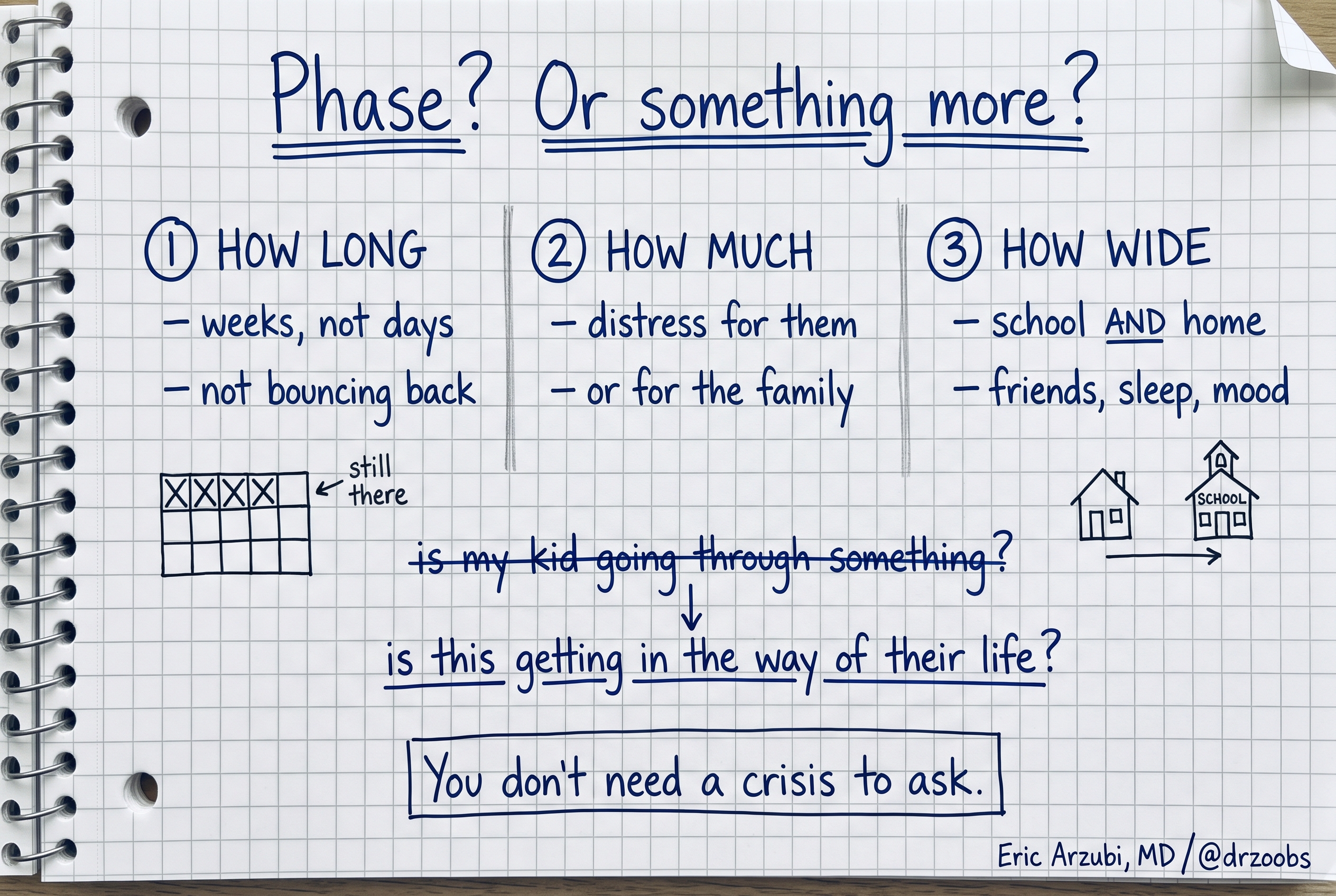
Three things move a normal rough patch into evaluation territory: how long it has lasted, how much distress it causes, and whether it is getting in the way of daily life. According to the National Institute of Mental Health, those are the factors to watch.
A single bad week is not a reason to call a psychiatrist. A pattern that has held for a month and is showing up at home and at school is.
That threshold matters. It shifts the question from "is my child going through something?" to "is this getting in the way of their life?"
Signs worth a closer look in younger children
Most lists of warning signs stop at what you see. This one adds what it may mean, because that is the question parents are actually asking.
Signs worth a closer look in older children and teens
The NIMH and the American Academy of Child and Adolescent Psychiatry both note that teen warning signs are often misread as attitude or laziness. Here is what to look for and why it matters.
If you have found evidence of self-harm. Most self-harm is not a suicide attempt, and finding it does not mean your child is in immediate danger. It does mean this should be looked at soon rather than watched for a few more weeks. Call your pediatrician or a psychiatric provider this week.
Treat it as an emergency and call 911, go to the nearest emergency room, call or text 988, or text HOME to 741-741 if the injury needs medical attention, if your child talks about wanting to die, or if you do not believe they can stay safe tonight.
The bottom line: you do not need to wait until things are in crisis. If something has changed and it is not getting better, that is enough of a reason to ask.
Who Does What: Psychiatrist, Therapist, Psychologist, Pediatrician
Parents often do not need a psychiatrist first. They need to know who to call. Here is the short version.
Psychologists cannot prescribe medication in Montana or Alaska. Idaho is one of a small number of states that allows specially trained psychologists to prescribe, which is why the row above says "usually."
Most families start with a therapist or their pediatrician, and that is often the right call. Frontier provides both therapy and psychiatry, so you do not have to guess correctly on the first try.
Common Reasons Families Seek Child and Teen Psychiatry Care
Parents usually arrive with a mix of concerns, not a clear diagnosis. Recognizing your child in one of these patterns does not tell you what is causing it. That is what the evaluation is for.
ADHD and attention concerns
Trouble focusing is one of the most common reasons families seek an evaluation. It looks like unfinished homework, constant distraction, impulsive behavior, or a child who seems bright but cannot turn that into results. The CDC notes that ADHD affects both focus and impulse control, and that symptoms often show up differently across settings.
Attention problems are not always ADHD. Sleep problems, anxiety, depression, and learning disorders all affect focus. An evaluation sorts out which one you are dealing with.
Is it ADHD or normal teenage behavior? Most teenagers are disorganized, distracted, and hard to get out of bed. Three things point toward ADHD rather than adolescence. First, the pattern started well before the teen years. Second, it shows up in more than one setting, not only at home or only in one class. Third, the consequences keep landing despite real effort. A teenager who genuinely tries and still cannot finish is different from one who has decided not to.
Anxiety and panic symptoms
Worry is a normal part of childhood. When fear starts limiting what a child can do, it crosses into something worth evaluating. The CDC notes that childhood anxiety includes separation anxiety, social anxiety, generalized anxiety, and panic disorder.
In kids, anxiety often does not look like worry. It looks like stomachaches, school refusal, irritability, or physical symptoms with no clear medical cause. Some anxious children are quiet about it, and their worries go unnoticed because they keep it inside instead of acting out.
Depression, sadness, and withdrawal
Depression in children and teens does not always look like adult depression. A teen who seems angry, irritable, or unmotivated may be depressed. So may a child who used to be social and has gone quiet. The CDC notes that depression can make kids look like troublemakers or seem lazy, which is why it often goes unnoticed.
Autism and developmental concerns
Some of the changes parents notice are developmental rather than emotional. Limited eye contact, delayed or unusual speech, repeated words or phrases, intense narrow interests, distress when routines change, or trouble reading other kids all point in that direction.
Autism is diagnosed by history and observation, not a blood test, and a psychiatric evaluation is a reasonable place to start when you are not sure what you are seeing. Frontier's providers diagnose and treat autism spectrum disorder. If your child needs formal standardized testing, such as an ADOS assessment or a full neuropsychological battery, that is a separate process and your provider will tell you where to get it.
Mood changes and behavior shifts
Sharp mood changes, emotional outbursts, aggression, or a sudden shift in personality can all be reasons to seek an evaluation. These patterns may reflect stress, trauma, a mood disorder, or something else. The evaluation is the tool for figuring that out.
How a Telehealth Psychiatric Evaluation Works for Kids and Teens
A virtual psychiatric evaluation is a real clinical evaluation. It is not a quick screen or a checklist. Initial evaluations at Frontier are 60 minutes. Follow-up visits are typically at least 30 minutes. We see patients ages 2 to 17, and most families get a first appointment within 14 days.
According to AACAP's guidance on comprehensive psychiatric evaluation, a full evaluation covers current symptoms, development, medical history, school performance, family relationships, and past care. Here is what that looks like in practice.
- Before the visit. A parent or caregiver fills out intake forms covering history, current concerns, medications, and school situation. This gives the provider a starting point.
- The opening conversation. The provider usually starts with the parent or caregiver, sometimes with the child in the room and sometimes not, depending on age and concern. The goal is simple: understand what changed, how long it has been going on, and how it is affecting daily life.
- Time with the child or teen. The provider spends time directly with your child. For younger kids this is shorter and more observational. For teens it is usually a more direct conversation. What the provider is listening for is how your child describes their own experience. Your report matters, but so does theirs.
- Questions across settings. School, friendships, sleep, appetite, and family life all give context. Symptoms that show up in several settings often mean something different from symptoms that show up in one.
- Safety questions. Every evaluation includes a careful safety assessment. This is standard, not a sign that anyone is alarmed.
- Next steps. At the end, the provider shares initial impressions and recommendations. That might be a follow-up visit, coordination with school or your pediatrician, therapy, medication, or watchful waiting.
One important boundary: telehealth works for many psychiatric evaluations. It is not appropriate for emergencies. If your child may be in immediate danger, that calls for in-person care. See the emergency section below.
Can a Telehealth Psychiatrist Prescribe Medication to My Child?
Yes. Frontier providers are physicians and psychiatric nurse practitioners who can prescribe medication after a telehealth evaluation, including stimulant medications for ADHD.
That last part surprises people, because the rules have changed several times. Federal law generally requires an in-person exam before a controlled substance can be prescribed. The DEA has repeatedly extended telemedicine flexibilities that allow stimulants and similar medications to be prescribed by telehealth without an in-person visit first, and those flexibilities are in effect as of this page's last review date. Frontier operates in full compliance with current DEA regulations governing controlled substance prescribing via telehealth. If the rules change, your provider will tell you what it means for your child before anything about your care changes.
A few things worth knowing:
- Medication is not the automatic outcome. An evaluation often ends with therapy, school accommodations, or a plan to watch and recheck. If medication is recommended, your provider will explain why, what it does, and what the side effects are. You will also hear what the alternatives look like if you would rather not.
- You can say no. Declining medication does not end the relationship or the care plan.
- Some plans require prior authorization. This is an insurance step, not a clinical one. It can add a few days. Your provider's office handles the paperwork.
- Controlled substances have extra rules. Stimulants generally cannot be refilled automatically and may require more frequent check-ins. That is normal.
What Parents Can Prepare Before the Visit
The more your provider knows going in, the more useful the hour is. You do not need to prepare a formal report. Gathering a few things ahead of time makes a real difference.
- A rough timeline of when you first noticed something was off and how it has changed
- Examples of specific behaviors or incidents that concern you, with dates if you remember them
- Current medications and doses, plus any supplements or over-the-counter products
- Any past diagnoses, evaluations, or mental health treatment, even years ago
- Medical history that might matter, including sleep problems, frequent headaches, or thyroid issues
- School records, report cards, teacher notes, or prior educational testing or IEP documents
- Sleep patterns, appetite changes, and recent major stressors such as a move, a loss, or a social conflict
- Family mental health history, if you know it
A note about preparing your child. Tell them honestly what the visit is for. Something like: "We're going to talk to a doctor who helps kids figure out what's been hard lately." You do not need to script their answers. An honest, unrehearsed conversation is more useful than a prepared one.
According to the AACAP, parents play a key role in the psychiatric evaluation process. Bring your concerns, including the ones you are not sure about.
When Your Teen Does Not Want to Go
This is common and it is not a reason to give up. A teenager who refuses an appointment is usually refusing one of three things: being labeled, losing control of the conversation, or being made to sit in a waiting room where someone from school might see them.
A few things that help:
- Make the first visit smaller than it feels. One conversation, no commitment to a second. That is an easier yes than "you're starting treatment."
- Give them control over the parts you can. Which day, which room in the house, whether you are in the room for the first ten minutes or the last.
- Do not promise it is not about them. Teenagers detect that immediately. Say what it is: someone whose job is to figure out why the last few months have been hard.
- Let them talk to the provider alone. For many teens this is the thing that turns the visit from an ambush into their own appointment.
This is one of the clearest advantages of telehealth over a drive to a clinic. The visit happens in their own room, nobody sees them walk in, and it does not cost a half day of school.
What your teen can keep private
Teens ask this before they ask anything else, and they deserve a straight answer.
Your provider will keep the substance of what your teen says confidential in most cases. That confidentiality is what makes the conversation useful. The exception is safety: if your teen is at risk of hurting themselves or someone else, or if there is abuse, the provider will tell you. Your provider explains these limits to your teen at the start, in plain language, so nobody is surprised later.
Frontier follows all minor consent and confidentiality laws in Montana, Idaho, and Alaska. Your provider will explain the specific limits that apply in your state at the start of the visit.
How School and Primary Care Coordination Can Help
A child's life does not happen in one place. School, home, and the pediatrician's office each see a different part of the picture.
Why school input matters. Teachers and counselors often notice things parents do not, and the reverse is also true. A child who holds it together at school and falls apart at home is telling you something different. So is a child who struggles academically but seems fine everywhere else. If a teacher has raised a concern, bring it. With your permission, your provider can also contact school staff directly.
Why primary care matters. Some of the symptoms that bring families to psychiatry have physical causes. Sleep problems, thyroid issues, anemia, chronic pain, and medication side effects all affect mood, focus, and behavior. Your pediatrician can rule those out.
Your pediatrician can also reach a child psychiatrist directly. Most states run a pediatric psychiatry access line, a free service that lets your child's primary care provider call and get advice from a child psychiatrist, usually the same day. Parents cannot call these lines, but you can ask your pediatrician to. It is one of the fastest ways to get expert input while you wait for an appointment. Most families never use it simply because they do not know it exists.
Here is where that stands in the three states we serve.
Montana: MAPP-Net (Montana Access to Pediatric Psychiatry Network) is available weekdays, 8:30 am to 4:30 pm Mountain, at 844-922-6277. Any MD, DO, nurse practitioner, or physician assistant can call for patients ages 0 to 21.
Alaska: PAL-PAK (Partnership Access Line Pediatric Alaska) is available weekdays at 855-599-7257. Any prescriber caring for children or teens in Alaska can call.
Idaho: No statewide line is operating yet. A pediatric psychiatry access line is in development through the University of Idaho. If you are in Idaho, ask your pediatrician to consult a child psychiatrist directly, or to begin treatment for a straightforward presentation such as mild anxiety while you wait for a psychiatry appointment.
Both operating lines are free, and both are underused, mostly because families do not know to ask. If you are in Montana or Alaska, the question to your pediatrician is simply: "Would you call the access line about this?"
If you are in Idaho, that option is not there yet. Ask your pediatrician to consult a child psychiatrist directly, or to start treatment for a straightforward presentation such as mild anxiety while you wait for a psychiatry appointment.
Key point: coordination between a psychiatric provider, a school, and a pediatrician does not happen on its own. It requires your consent and your involvement. When it works, it produces a clearer picture and a more practical plan.
When Telehealth Is Not Enough: Urgent and Emergency Situations
Routine scheduling is not the right path when a child may be in immediate danger. If you are in that situation, stop reading and get help now.
If your child is in immediate danger, call 911 or go to the nearest emergency room.
- Call or text 988 (Suicide and Crisis Lifeline) for immediate crisis support
- Text HOME to 741-741 (Crisis Text Line) to reach a trained crisis counselor by text
- These resources are free, confidential, and available 24 hours a day
In our three states, 988 is answered in state: by the Montana Crisis Lifeline, by the Idaho Crisis and Suicide Hotline, and in Alaska by Careline Alaska. You can also reach Careline directly at 877-266-4357.
Situations that require immediate in-person help
- Suicidal thoughts with a plan or intent to act
- Self-harm that requires medical attention
- Threats of violence toward others
- Severe confusion, disorientation, or loss of contact with reality
- Hallucinations causing fear or unsafe behavior
- Overdose or suspected substance ingestion
- Any situation where your child cannot be kept safe at home
The NIMH is direct on this: if a child's behavior is unsafe, or if they talk about wanting to hurt themselves or someone else, seek help immediately.
If you are unsure whether a situation is an emergency, treat it like one.
Common Questions
How do I know if my child needs to see a psychiatrist?
Look at duration, distress, and interference. If a change in mood, focus, sleep, or behavior has lasted several weeks, is upsetting to your child or your family, and is getting in the way of school, friendships, or home life, an evaluation is reasonable. You do not need certainty first.
What are five symptoms that a child may have a mental health disorder?
Persistent sadness or irritability lasting two weeks or more, withdrawal from friends and activities they used to enjoy, major changes in sleep or appetite, a sudden drop in school performance, and frequent physical complaints such as stomachaches or headaches with no medical cause.
At what age do children show signs of mental illness?
Earlier than most parents expect. Anxiety and behavioral conditions often appear by ages 5 to 8, ADHD is usually recognizable by early elementary school, and depression becomes more common in the teen years. Autism signs often show up before age 3. Age alone does not rule anything out.
How do I get a psychiatrist for my child?
You can contact a child and adolescent psychiatry practice directly. Many, including Frontier, do not require a referral. Bring your child's school records, medication list, and a rough timeline of what changed. In Montana and Alaska your pediatrician can also call the state pediatric psychiatry access line for advice while you wait, at 844-922-6277 and 855-599-7257 respectively.
Can an online psychiatrist prescribe medication?
Yes. Physicians and psychiatric nurse practitioners can prescribe by telehealth, including ADHD stimulant medications under the DEA telemedicine flexibilities currently in effect. Prescriptions go to the pharmacy of your choice. Some medications require prior authorization from your insurance first.
How long does a child psychiatric evaluation take?
An initial evaluation at Frontier is 60 minutes. That time is split between the parent or caregiver, the child or teen directly, and a closing conversation about next steps. Follow-up visits are typically at least 30 minutes. If your child needs a more comprehensive psychological or neuropsychological evaluation, that is a separate process. It can take several hours across one or more sessions.
What does a child psychiatric evaluation cost?
For families paying out of pocket, an initial evaluation is $400 and follow-up visits are $250. Most major insurance plans are accepted, including Medicaid and the children's coverage programs in all three states: Healthy Montana Kids, Idaho Medicaid, and Denali KidCare in Alaska. All three cover children's behavioral health. Check your coverage before your first visit to confirm your benefits.
Key Takeaways
- Persistent changes in mood, focus, behavior, sleep, or school functioning are worth taking seriously, especially when they last weeks and affect more than one part of life.
- A psychiatric evaluation is a way to understand what may be going on. It is not a diagnosis made in advance and not a commitment to any treatment.
- A telehealth psychiatrist can prescribe medication, including ADHD stimulants, but medication is not the automatic outcome of an evaluation.
- Preparing a timeline, school records, medications, and family history helps your provider make the most of the visit.
- If your teen refuses to go, a first visit in their own room with time alone with the provider is often the version they will accept.
- Emergencies need immediate in-person care. Call 911, go to the nearest ER, call 988, or text HOME to 741-741.
A Reasonable Next Step
You do not need to have everything figured out before asking for help. If you have been noticing changes that are not going away, an evaluation can clarify what is happening and what makes sense to do next.
Frontier Psychiatry provides child and teen telepsychiatry and therapy for families in Montana, Idaho, and Alaska. No referral is required, most major insurance plans are accepted, and most families are seen within 14 days.
Get started online or check your insurance coverage first.
If your child may be in immediate danger or cannot stay safe, do not schedule a routine visit. Call 911, go to the nearest emergency room, call 988, or text HOME to 741-741.