

Alaska's Youth Suicide Rate Hit a 10-Year High. The Most Important Number in the State's Report Isn't the One Making Headlines.
TL;DR
The short version for parents who need it fast:
- Alaska's youth suicide rate is among the highest in the country. The 2025 fatality rate was the worst single year in a decade.
- Alaska Native youth carry the highest rates of any group in the state.
- Boys die far more often than girls, not because they suffer more, but because of what was within reach when the crisis hit. Means safety is the highest-leverage intervention.
- A suicidal crisis in a teenager is usually survivable. The 4,101 documented attempts in the state bulletin are overwhelmingly kids who are still alive.
- Ask directly. Secure firearms and medications now. Don't wait for a crisis to get an evaluation.
- Call or text 988. Text HOME to 741-741. Alaska Careline: 1-877-266-4357.
By Eric Arzubi, MD. Board-certified child and adolescent psychiatrist, co-founder and CEO of Frontier Psychiatry.
If a young person is in immediate danger, call 911.
If you or someone you know is struggling or in crisis, help is free, confidential, and available 24 hours a day:
- Call or text 988 to reach the Suicide and Crisis Lifeline, or chat at 988lifeline.org
- Text HOME to 741-741 to reach the Crisis Text Line
- In Alaska, call the Careline at 1-877-266-4357, answered 24/7, 365 days a year
If you are a parent, put all three of these in your child's phone tonight. Many teenagers will text when they will not call, and a number they already have is a number they can reach at 2 a.m. without deciding to ask for help first.
Alaska's August 2026 state epidemiology bulletin on youth suicides made headlines for one number. That number was a ten-year high fatality rate. That number deserves the attention it is getting. But there is another number buried in the same report that most coverage has not touched, and it is the one that most directly points to what families can do right now to protect a young person they are worried about.
This article is for parents, family members, teachers, and anyone in Alaska watching a teenager struggle. It breaks down what the bulletin found and explains why the attempt-to-death ratio is the most important statistic in the report. It also gives concrete steps that can be taken this week, before a crisis, not after.
What the state's report found, and what it means clinically
On August 24, 2026, the Alaska Department of Health's Section of Epidemiology published Bulletin No. 11, Youth Suicides in Alaska, 2016–2025. Over that ten-year period:
- 174 Alaskans under 18 died by suicide, a rate of 19.2 per 100,000 youth ages 10 to 18 across the decade. Median age at death: 16.
- 4,101 suicide attempts were documented, a rate of 451 per 100,000.
- The fatality rate in 2025 was the highest recorded in the ten years the bulletin covers.
- Alaska Native youth had the highest fatality and attempt rates of any group in the state.
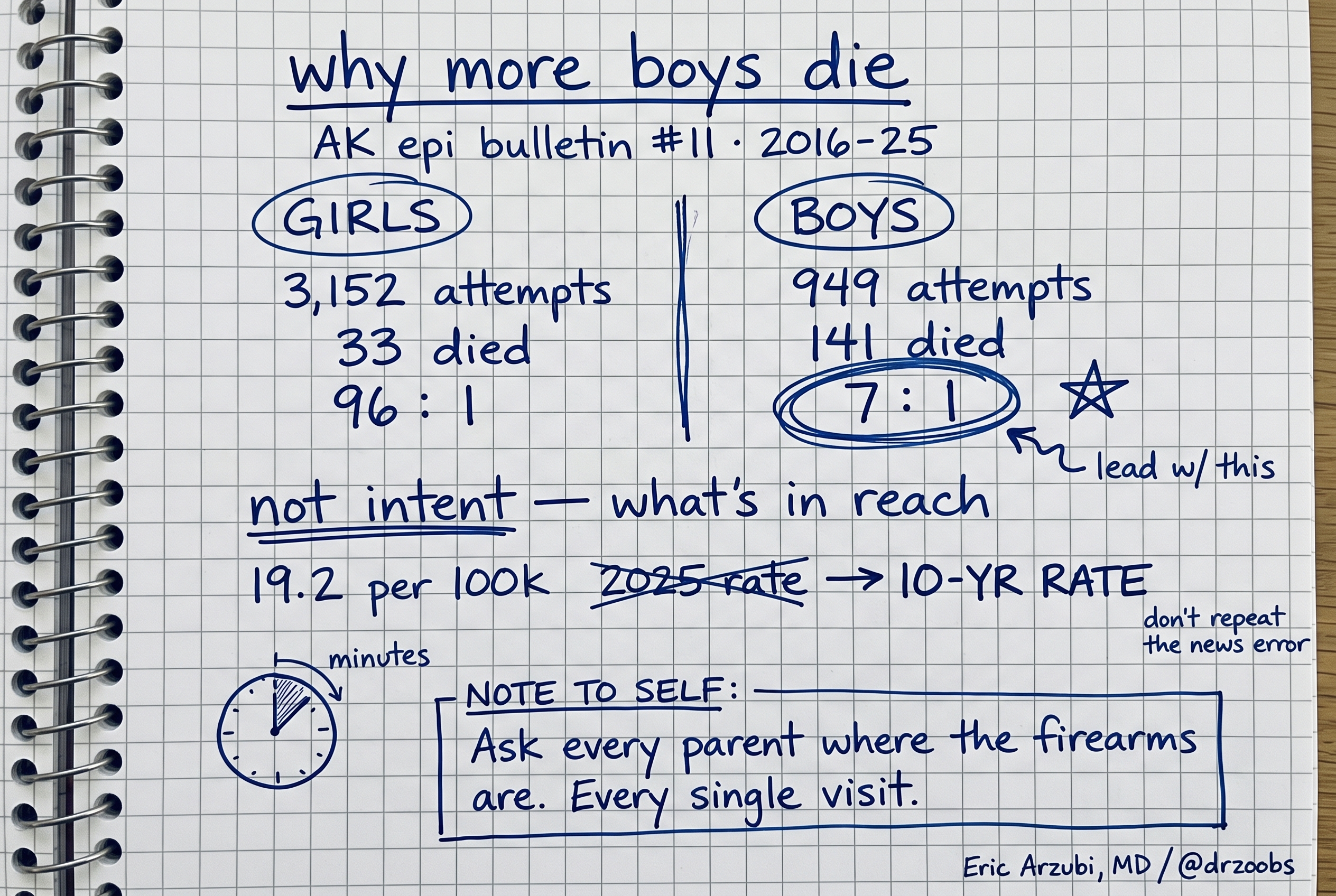
One clarification, because it has been reported inconsistently. 19.2 per 100,000 is the rate across the full 2016 to 2025 decade, not the 2025 figure. What the bulletin says about 2025 is that it was the worst single year of the ten. Both facts are alarming. They are not the same fact.
Now the number that I think matters most, and that has gone almost entirely unmentioned in the coverage:
Among Alaska girls, there were 96 documented suicide attempts for every death. Among Alaska boys, there were 7.
Same state. Same decade. A fourteen-fold difference in how often an attempt proves fatal. Boys made under a third as many documented attempts as girls (949 versus 3,152) and accounted for 141 of the 174 deaths.
That gap is not a difference in how much these kids are suffering. It is almost entirely a difference in what was within reach when they acted.
Why the ratio is the whole story
In adolescent psychiatry we distinguish between intent and lethality, and the distinction is the difference between a survivable night and a funeral.
Suicidal crises in teenagers are often astonishingly brief. The window between the impulse and the act can be minutes. What determines whether a young person is alive the next morning is rarely the depth of their despair. It is what they could reach in those minutes.
The bulletin bears this out in the numbers:
More than half of all youth deaths involved a firearm, and firearms were involved in the clear majority of deaths among boys. Attempts, by contrast, overwhelmingly involved medications kept around the house. That is precisely why the attempt-to-death ratio for girls is 96:1 and for boys is 7:1.
I want to be explicit about something. These statistics can read as fatalism. A suicidal crisis in a teenager is usually survivable. Survivors mostly do not go on to die by suicide. The 4,101 attempts in that bulletin are overwhelmingly 4,101 young Alaskans who are still here. The clinical task is to make survival the likely outcome of a crisis, not a coin flip. Means safety is the highest-leverage way to do that.
There is a second clinical signal worth naming. Thirty percent of the girls who died had a documented prior attempt. The figure for boys was 17%. For girls, a prior attempt is often the loudest warning we will ever get. The weeks after a first attempt are the highest-risk period in the entire course of suicidal thinking in a teenager's life. The state's bulletin recommends strengthened follow-up after an attempt for exactly this reason.
In my experience the follow-up visit is almost never refused. It is simply never made. The family leaves the emergency department exhausted and relieved. The teenager looks better for a week or two. The visit gets pushed. In a state where pushing it means waiting three months for the next opening, pushed becomes never.
Why Alaska, specifically
There is no single cause. Alaska has a set of risk factors that stack. The stacking is the problem.
Distance
Most of Alaska is not on the road system. A family in a village off the Kuskokwim, on Prince of Wales Island, or in the Interior north of Fairbanks may be a flight and a weather delay from the nearest child psychiatrist. That is not a figure of speech. Alaska has long had one of the lowest per-capita supplies of child psychiatrists in the country. What supply exists is concentrated in Anchorage. When a fifteen-year-old starts sliding in October, "we can see her in four months, in Anchorage" is not a treatment plan. It is a waiting list.
Darkness and seasonality
Alaska's winter light cycle is genuinely extreme, and seasonal shifts in mood are a measurable clinical phenomenon, not a folk belief. Seasonality compounds existing depression more than it creates new depression. But for an adolescent already struggling, November through February is when things tend to get worse. We've written separately about seasonal affective disorder in Alaska.
Access to lethal means
Firearms are woven into subsistence life and personal safety across rural Alaska, and that is not going to change. This is not an argument about ownership. It is an argument about timing and about a temporary intervention during a defined period of risk.
A workforce that was never sized for the geography
This is the piece I know best, because it is the problem Frontier Psychiatry was built to solve. Alaska does not have, and will not soon have, enough child psychiatrists physically located near the families who need them. Waiting for that to change is not a strategy.
Alaska Native youth: whose expertise this is
The bulletin found that Alaska Native youth carried the highest suicide fatality and attempt rates of any group in the state. News coverage of the bulletin reported figures more than double the statewide rate for both.
I am not the right person to explain why, and I want to be careful not to pretend otherwise. What I can say is that this disparity is not explained by individual clinical risk factors. The most credible work on it is led by Alaska Native researchers and Tribal health organizations, not by providers like me.
Two bodies of work are worth knowing about.
Alaska Native Collaborative Hub for Research on Resilience (ANCHRR)
Led by Stacy Rasmus, PhD, with Lisa Wexler, PhD and James Allen, PhD, ANCHRR works across 65 villages in three Alaskan regions. Its premise inverts the usual clinical frame. Rather than cataloguing risk, it identifies and strengthens the protective factors communities already possess. Their Alaska Community Resilience Mapping work helps communities build on existing assets rather than remediate deficits.
Alaska Native Tribal Health Consortium
ANTHC runs suicide prevention training across the state, including ASIST, safeTALK, and Mental Health First Aid. It also offers the Alaska Blanket Exercise, developed with Elders and knowledge keepers to address intergenerational trauma directly. ANTHC also runs a telehealth mental health and wellness clinic.
The state bulletin's own recommendation is culturally responsive prevention and postvention. For non-Native providers working in Alaska, including us, the role is to be genuinely available and to defer to Alaska Native-led programs on approach. Not to show up with a model.
What warning signs actually look like in a teenager
Parents often tell me they were watching for sadness. Adolescent depression frequently does not present that way. What to watch for:
- Withdrawal from things they used to care about: a sport, a friend group, hunting or fishing with family, a game they played constantly.
- Irritability and anger, not just low mood. In teenagers, and especially in boys, depression often looks like a short fuse.
- Sleep and appetite changes persisting beyond two weeks.
- A drop in school performance without an obvious explanation.
- Giving away possessions, or talking about being a burden: "you'd be better off," "it doesn't matter anyway."
- Increased alcohol or substance use.
- A sudden, unexplained calm after visible distress. Frequently missed, and clinically important.
- Any prior suicide attempt. Per the bulletin, this is a stronger signal in girls, but it is a serious signal in anyone.
- Any direct statement about wanting to die. Take it literally. Every time.
Asking a young person directly about suicide does not plant the idea. This is among the most persistent myths in my field. The evidence against it is unambiguous. Asking plainly, "Are you thinking about killing yourself?" most often produces relief. It signals that the subject is survivable enough to say out loud.
What families in Alaska can do this week
1. Ask directly, and listen before problem-solving. The instinct to fix is strong. Sit in it with them first.
2. Make the home less lethal, temporarily. Store firearms outside the home with a trusted person during a period of risk, or lock them in a safe with ammunition stored separately. Lock up medications, including ordinary over-the-counter ones. This is temporary. It is not a judgment on your family. Given a 7:1 ratio for boys, it is the intervention most likely to keep your child alive.
3. Don't wait for a crisis to seek an evaluation. The most common thing I hear from families is that they weren't sure it was "bad enough" yet. An evaluation is not a commitment to medication and not a label. If you are reading this paragraph twice, that is your answer. More on when a child or teen needs a psychiatric evaluation.
4. If there has already been an attempt, treat the next eight weeks as the priority. Get the follow-up appointment on the calendar before you leave the emergency department, and keep it even if things seem better. Especially if things seem better.
5. Put the crisis lines in their phone, and use them before it is an emergency. Call or text 988, or text HOME to 741-741. Neither is only for imminent danger. They are for the Tuesday at 11 p.m. when you don't know what to do next. Texting matters here. Plenty of teenagers who would never make a phone call will type to a stranger. A young person in a house with thin walls may not be able to speak out loud at all.
6. Loop in the school. Counselors are frequently the first to notice and can often move faster than a family alone.
What telepsychiatry actually changes
I have an obvious stake in this, so take it as an argument I am interested in, and then check it against the data.
Telepsychiatry does not create more child psychiatrists. What it removes is geography as the rationing mechanism. A family in Bethel and a family in Anchorage can see the same subspecialist in the same week, from home. No flight. No weather delay. No missed school days. No waiting for a provider to move to a town of 800.
A 2025 study in JAMA Network Open compared 2,686 Montana Medicaid patients treated in our clinic against 2,686 matched controls. The telepsychiatry group had a 38.0% lower annualized hospitalization rate and a 17.9% lower rate of emergency department admissions. Overall per-member-per-month cost was comparable.
Two honest caveats. Telepsychiatry is not crisis response. If a young person is in immediate danger, that is 911 and an emergency department, not a video visit. And connectivity across rural Alaska remains uneven, though many of our visits run fine on a phone connection.
What it is very good at is the unglamorous work that prevents crises. Evaluating a depressed sixteen-year-old in days rather than months. Adjusting a medication before the school year collapses. Being reachable for the post-attempt follow-up the state's bulletin says we are missing.
Frequently asked questions
What is Alaska's youth suicide rate? Per Alaska Epidemiology Bulletin No. 11 (August 2026), 174 Alaskans under 18 died by suicide between 2016 and 2025, a rate of 19.2 per 100,000 youth ages 10 to 18 across that decade. The 2025 fatality rate was the highest single year in the ten-year period. Alaska's overall suicide rate across all ages, roughly 29.7 per 100,000, is among the highest in the United States according to CDC data.
Why do more Alaska girls attempt suicide but more boys die? Girls accounted for about three-quarters of documented attempts; boys accounted for 141 of 174 deaths. The attempt-to-fatality ratio is roughly 96:1 for girls and 7:1 for boys. The difference is driven primarily by the lethality of the method available, not by differences in intent or distress. That is why restricting access to lethal means during a crisis is such an effective intervention.
What is the crisis text line for teenagers in Alaska? There are two. Texting 988 reaches the Suicide and Crisis Lifeline, which also serves as Alaska's Careline. Texting HOME to 741-741 reaches the Crisis Text Line. Both are free, confidential, and staffed around the clock. Alaskans can also call the Careline directly at 1-877-266-4357.
Does asking my teenager about suicide make it more likely? No. Research consistently shows that asking directly does not increase risk and often reduces distress. Ask plainly and take any answer seriously.
How quickly can a young person in Alaska see a psychiatrist? It depends on location and whether care is in person or virtual. In-person child psychiatry is concentrated in Anchorage and waits can run months. Frontier Psychiatry typically matches patients with a licensed provider for a virtual visit within about a week, and no referral is needed.
Is telepsychiatry covered by insurance in Alaska? Generally yes. Frontier Psychiatry is insurance-based and in network with most major plans, including Medicaid, Medicare, TRICARE, Blue Cross Blue Shield, and UnitedHealthcare. We run a benefits check before the first visit.
What if my child refuses to go? Common, and workable. Start with a consultation for yourself as a parent. Adolescents frequently agree to a video visit after refusing an in-person one. The setting feels less exposed.
If you are reading this because you are worried about someone
Ask the direct question. Secure the firearms and the medications today, not next week. Call or text 988 if you need to talk it through with someone right now, or text HOME to 741-741.
Then get an evaluation scheduled. Not because a crisis is inevitable, but because the treatable window is wider than most families realize, and it is widest before things get worse.
Frontier Psychiatry provides child and adolescent psychiatric care to families across Alaska, Montana, and Idaho: all virtual, insurance-based, usually within a week. Get a psychiatric evaluation started. No referral needed.
Learn more about our child and adolescent services, or contact our team about coverage and scheduling.
Related reading: Why is suicide such a problem in Idaho? · YAM: a lifesaving youth suicide prevention program · Seasonal affective disorder in Alaska
Sources
- Youth Suicides in Alaska, 2016–2025. State of Alaska Epidemiology Bulletin No. 11, August 24, 2026. Fitting R, Hannigan A, Prater C.
- Alaska Suicide Facts & Statistics. State of Alaska, Department of Health.
- Suicide Mortality by State. CDC, National Center for Health Statistics.
- Medicaid Costs and Outcomes for Patients Treated in an Outpatient Telepsychiatry Clinic. JAMA Network Open, May 2025.
- Alaska Native Collaborative Hub for Research on Resilience (ANCHRR). National Institute of Mental Health.
- Behavioral Health programs. Alaska Native Tribal Health Consortium.
- Careline Alaska and Crisis Text Line.
Eric Arzubi, MD is a board-certified child and adolescent psychiatrist and the co-founder and CEO of Frontier Psychiatry. He previously chaired the department of psychiatry at Billings Clinic.
This article is for educational purposes and is not a substitute for individual medical advice. If you are in crisis, call or text 988, text HOME to 741-741, call the Alaska Careline at 1-877-266-4357, or call 911.