

Your first online psychiatry appointment is a private video visit with a licensed psychiatric provider. At Frontier, that is most likely a psychiatrist (MD or DO), a psychiatric nurse practitioner, or a physician assistant with specialty training in mental health. All are qualified to evaluate, diagnose, and prescribe within their scope of practice. You will talk through your symptoms, health history, goals, and what support may help. By the end, you should have a clear picture of your next step, whether that is further assessment, a treatment plan, medication, therapy, or a combination.
For patients in Montana, Idaho, and Alaska, that visit happens from home. No referral needed. No long drive to a city. Most insurance accepted, including Medicaid, Medicare, and Blue Cross Blue Shield.
If you have been putting off getting help because you were not sure what a psychiatric appointment actually involves, this guide is for you.
Key takeaway: A first telepsychiatry appointment is a structured clinical conversation, not a test. Your provider's job is to understand what you are going through and help you figure out next steps together.
How to Prepare for Your First Psychiatric Visit
A little preparation makes the visit more useful for both you and your provider. You do not need medical records or a referral letter. Here is everything worth doing before you log on.
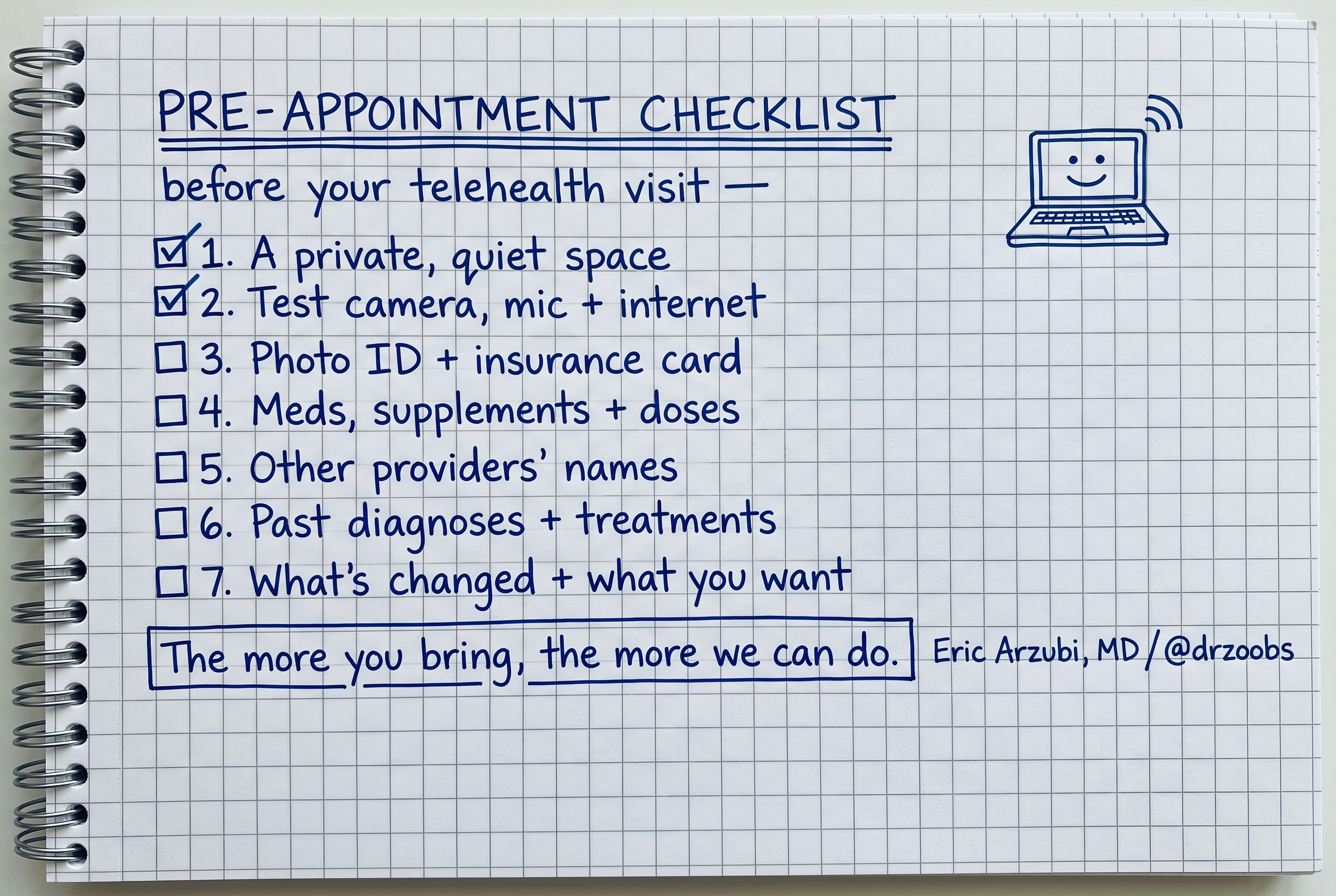
Pre-appointment checklist
- Find a private, quiet space where you can speak openly
- Test your camera, microphone, and internet connection
- Have your photo ID and insurance card handy
- Write down your current medications, supplements, and doses
- Note the names of your primary care clinician, therapist, or other providers
- Jot down any past diagnoses, treatments, or hospitalizations that feel relevant
- Write a few sentences about what has changed recently and what you want help with
You do not need to have everything organized perfectly. Even a few notes on your phone is enough. The goal is to give your provider a starting point.
Set up a private, quiet space
Find somewhere you can speak openly without being overheard. A bedroom with the door closed, a parked car, or a quiet room at home all work. If privacy at home is difficult, let your provider know at the start of the visit. For patients in small towns where running into someone at a clinic feels like a real concern, this is one of the practical advantages of telehealth.
Check your technology
You will need a reliable internet connection and a device with a working camera and microphone. A smartphone, tablet, or laptop all work. Test your audio and video beforehand so you are not troubleshooting during the appointment. If your connection is slow, a wired connection or moving closer to your router can help.
Know what to bring up
Come ready to describe what has been difficult, how long it has been going on, and what you have already tried. You do not need a diagnosis in mind. Your provider's job is to help figure that out. If there is something specific you want answered by the end of the visit, write it down so you do not forget to ask.
What Happens During Your First Telepsychiatry Visit
First appointments at Frontier are 60 minutes. Here is how that time usually unfolds.
Step 1: Confirming privacy and getting settled
Your provider will introduce themselves, confirm your identity and location, and check that you have a private space to talk. This is standard clinical practice for telehealth, not unusual.
Step 2: Talking about what brought you in
Your provider will ask open-ended questions about what has been difficult. Expect questions about:
- How long you have been experiencing symptoms
- How symptoms affect your sleep, work, relationships, and daily life
- What has changed recently
- What you have already tried
There is no right or wrong answer. You do not need to have a diagnosis in mind. Just describe what has been happening.
Step 3: Reviewing your health and treatment history
Your provider will ask about your medical history, any prior mental health treatment, current medications, family history when relevant, and your current support system. Be as honest as you can. This information helps your provider understand the full picture.
Step 4: Discussing a care plan
Toward the end of the visit, your provider will share their clinical impression and talk through possible next steps. Depending on your situation, that might include:
You are not committed to anything after a first appointment. It is a conversation, not a contract.
Step 5: Scheduling follow-up
Psychiatric care is rarely a one-visit solution. Before the appointment ends, your provider will typically recommend a follow-up timeline. Ask any remaining questions before you log off.
Is Online Psychiatry as Effective as In-Person Care?
This is one of the most common questions patients in rural areas ask, and it is a fair one.
For most outpatient psychiatric needs, a secure video appointment allows patients and providers to have the same core clinical conversation they would have in an office. Research published in JAMA Network Open, including a study co-authored by Frontier Psychiatry's own clinical team, has found that telepsychiatry patients show meaningful reductions in hospitalizations and emergency department visits compared to those receiving no care.
Telepsychiatry tends to work especially well when:
- You live far from a psychiatric specialist
- Driving hours to an appointment is not realistic because of weather, distance, work, or caregiving responsibilities
- You need consistent follow-up care over months
- You prefer the privacy and comfort of receiving care from home
When in-person care may be more appropriate:
- You are in crisis or need immediate safety assessment
- Your provider recommends in-person evaluation for a specific clinical reason
- You are starting certain intensive treatments that require on-site monitoring
The most important variable is not the screen. It is finding a qualified provider who takes time to understand your situation. That is what Frontier was built to deliver, specifically for patients in Montana, Idaho, and Alaska who have historically had the fewest options.
Important: Telepsychiatry is not a substitute for emergency care. If you or someone you know may be in danger, call 911, call or text 988 (Suicide and Crisis Lifeline), or text HOME to 741-741 (Crisis Text Line), all available 24 hours a day, 7 days a week.
Will Medication Come Up at the First Appointment?
It may, but medication is one part of a broader conversation, not a guaranteed outcome of a first visit.
Your provider will review your symptoms, health history, current medications, and treatment goals before making any recommendations. If medication seems clinically appropriate, your provider will walk you through the options, explain potential benefits and risks, and discuss alternatives. You are never obligated to start a medication you are not comfortable with.
A few practical points worth knowing:
- Prescriptions go to your local pharmacy. You do not need to travel anywhere to fill them.
- Your provider will want to follow up. Medication management is an ongoing process, not a one-time decision. Follow-up appointments at Frontier are always at least 30 minutes, because meaningful psychiatric care cannot happen in a rushed 15-minute check-in.
- Coordinate with your other providers. If you have a primary care clinician or therapist, your Frontier provider can communicate with them to make sure your care is aligned.
If medication is not recommended at your first visit, that is not a sign something went wrong. Some patients benefit most from therapy, lifestyle changes, or a combination of approaches. Your provider will explain their thinking.
What Parents Should Know About a Child's First Appointment
Booking a psychiatric appointment for a child or teenager brings its own set of questions. Here is what to expect at Frontier.
Parent and guardian involvement matters. For younger children especially, a parent or guardian is often an important part of the conversation. Your provider may ask about your child's development, school performance, sleep, behavior at home, and any significant stressors or life changes.
Older teens may have some privacy. Adolescents may have part of the conversation with the provider independently, which is developmentally appropriate and clinically standard. Your provider will use their judgment about when that is helpful.
What to bring to a child's first appointment:
- School reports, teacher feedback, or prior evaluations (IEP, 504 plan, neuropsychological testing)
- A list of current medications and any prior diagnoses
- Your observations: what you have noticed at home, how long it has been happening, and what has changed
- Your questions, including what you hope the appointment will help clarify
Frontier offers child and adolescent psychiatry for patients across Montana, Idaho, and Alaska. If your child has been struggling and your nearest pediatric specialist has a months-long waitlist, a telehealth evaluation can be a meaningful first step.
Getting Started in Montana, Idaho, and Alaska
Frontier was built for patients in states where the mental health system has historically left rural communities without realistic options. The barriers are not the same in every state. Here is what the landscape actually looks like, and what it means for getting care.
Montana: A Shortage Crisis That Makes Telehealth Essential
Montana's psychiatric workforce shortage is not a talking point. It is documented in state data. As of 2024, 51 of Montana's 56 counties are designated mental health professional shortage areas by the federal government. Montana ranks 45th out of 51 states for overall mental health care access, according to the Montana Department of Public Health and Human Services. Nearly 50% of Montanans report cost as a barrier to getting care.
For patients outside Billings, Missoula, or Bozeman, the practical reality is this: the nearest psychiatrist may be hours away, and their waitlist may stretch months.
What this means for you:
- No referral is required to start with Frontier. You do not need your primary care clinician to send you anywhere.
- Montana Medicaid reimburses for all four major telehealth modalities, meaning most Medicaid patients can access care with no additional out-of-pocket cost for the visit itself.
- Frontier serves all 56 Montana counties. Whether you are in Glendive, Havre, or a town without a stoplight, you can be seen.
- Most major insurance is accepted, including Medicaid, Medicare, and Blue Cross Blue Shield of Montana.
The distance is real. The shortage is real. Telehealth does not solve every problem in Montana's mental health system, but for most outpatient psychiatric needs, it closes the gap that geography created.
Idaho: Structural Gaps and What to Know Before You Book
Idaho's rural psychiatric access problem mirrors Montana's in some ways and differs in others. Provider shortages in eastern and northern Idaho are significant, with many communities having no local psychiatrist or psychiatric nurse practitioner within a reasonable drive. Even in Boise, where most of Idaho's psychiatric workforce is concentrated, waitlists at established practices can stretch months. Patients in Twin Falls, Pocatello, Idaho Falls, and Coeur d'Alene often find that the nearest available provider is booked out or not accepting new patients.
Where Idaho diverges from Montana is on the policy side. Unlike Montana, Idaho has not passed telehealth parity legislation, which means insurance coverage for virtual visits varies more by plan. Medicaid reimbursement for telehealth in Idaho is more limited than in Montana or Alaska. This does not mean care is unavailable, but it does mean verifying your coverage before your first appointment is worth doing.
What this means for you:
- No referral is required to see a Frontier provider in Idaho.
- Insurance coverage varies by plan. Check your eligibility before booking so there are no surprises.
- Broadband access in rural Idaho can be inconsistent. If your home connection is unreliable, a smartphone on a cellular network often works better than a slow home Wi-Fi signal for a video visit.
- Frontier serves patients across Idaho, including Boise and the Treasure Valley, the Panhandle, the Magic Valley, and eastern Idaho where in-person psychiatric options are scarce.
If cost or coverage is a concern, Frontier's team can help clarify what your plan covers before you commit to an appointment.
Alaska: Geography, Isolation, and Why Telehealth Is Not Optional Here
Alaska's mental health access challenge is in a category of its own. Geographic isolation is not a metaphor here. For patients in communities outside Anchorage, Fairbanks, or Juneau, in-person psychiatric care has historically meant either a flight, a long ferry ride, or no care at all.
Alaska's telehealth policy allows licensed providers to deliver care without a prior in-person visit, which removes a barrier that exists in some other states. The state has partial telehealth parity in place, meaning many insurance plans are required to cover virtual visits comparably to in-person ones, though the rules vary by payer.
The practical challenge for many Alaskans is infrastructure. High-speed internet is not available everywhere. In communities served by satellite internet or limited cellular coverage, connection quality can affect the video visit experience.
What this means for you:
- Frontier serves patients across Alaska, including remote communities and areas outside the major population centers.
- You do not need to have seen a provider in person first. A telehealth evaluation is a valid starting point.
- If your internet connection is slow or unreliable, a smartphone on cellular often performs better than satellite-dependent home broadband for video calls. Let your provider know at the start of the visit if you are concerned about connection quality.
- Most major insurance is accepted, including Medicaid and Medicare. Check your coverage if you are unsure what your plan includes for telehealth.
For Alaskans who have gone without psychiatric care because the logistics made it impossible, a 60-minute visit from home is not a compromise. For most patients, it is simply the only realistic option, and it works.
Ready to get started? Fill out Frontier's new patient form to get matched with a provider. Most patients are seen within two weeks.
Questions to Ask at Your First Appointment
You do not need to have all the answers. But having a few questions ready helps you get more out of the visit.
- What do you think may be contributing to my symptoms?
- Do I need further evaluation or testing?
- What treatment options make sense for my situation?
- Would therapy, medication, or both be helpful?
- How soon should I follow up?
- Can you coordinate with my primary care clinician or therapist?
- What should I do if my symptoms get worse between appointments?
- What does ongoing care look like if I continue with Frontier?
Write these down before the visit. It is easy to forget in the moment, and your provider will appreciate that you came prepared.
Frequently Asked Questions
Do I need a referral to see a Frontier psychiatrist?
No. Frontier does not require a referral. You can get started directly by completing the new patient form, and you will be matched with a provider who fits your needs.
How long is a first appointment?
Initial evaluations at Frontier are 60 minutes. Follow-up appointments are always at least 30 minutes. Frontier does not do 15-minute medication checks. Your provider will use that time to conduct a thorough assessment and have a real conversation about your care.
What technology do I need?
A smartphone, tablet, or computer with a working camera and microphone, plus a reliable internet connection. Frontier uses a secure video platform. You do not need to download a separate app.
Can an online psychiatrist prescribe medication?
Medication may be discussed and prescribed when clinically appropriate, based on your evaluation, health history, and your provider's clinical judgment. Your provider will explain what they can and cannot prescribe and why.
Can my child have a telepsychiatry appointment?
Yes. Frontier offers child and adolescent psychiatry for patients across Montana, Idaho, and Alaska. A parent or guardian is typically involved in the first appointment for younger patients.
Is my appointment private?
Appointments are conducted through a secure, HIPAA-compliant video platform. Your information is not shared without your consent except as required by law.
What if I need help urgently before my appointment?
If you or someone you know is in immediate danger, call 911. For mental health crisis support, call or text 988 (Suicide and Crisis Lifeline), or text HOME to 741-741 (Crisis Text Line), both available 24 hours a day, 7 days a week. Telepsychiatry is not a substitute for emergency care.
Written and reviewed by Eric Arzubi, MD, Board Certified Psychiatrist, Assistant Clinical Professor at the Yale Child Study Center, and CEO and Co-Founder of Frontier Psychiatry. Dr. Arzubi has spent over a decade building psychiatric programs in rural communities across Montana and the Pacific Northwest. Learn more about Frontier's clinical team.
Ready to take the next step?
Frontier Psychiatry serves patients across Montana, Idaho, and Alaska with no referral required and most insurance accepted.
Get Started | Check Insurance Coverage