


Most people starting psychiatric medication for the first time have the same fear: not knowing what happens next, or what the first few months are actually supposed to look like.
How long until it works? What if it doesn't? Who do you call if something feels off and your next visit is six weeks away?
For people in Montana, Idaho, and Alaska, there's an extra layer. Your nearest pharmacy might be an hour away. Your PCP is already stretched thin. You shouldn't have to manage this alone between visits.
This guide is the honest version of what the first 90 days actually look like at Frontier Psychiatry. Not the marketing version. The real one: what your provider is watching for, when to expect to feel something, what happens if the first medication isn't right, and how Frontier's clinical pharmacist, something almost no telehealth practice has, changes the experience for rural patients.
TL;DR
- Starting psychiatric medication via telehealth is a 90-day process, not a single event.
- Most patients have two to three visits: an evaluation, a follow-up at four to six weeks, and a 90-day check-in.
- Medications take two to six weeks to work. Early weeks rarely tell the full story.
- Frontier has a clinical pharmacist on staff, something almost no psychiatric practice offers. She can be brought in for a consult when your medication regimen is complex, or you can request a review yourself.
- If something feels off before your next visit, message your care team. Don't wait it out.
Who Is on Your Care Team at Frontier?
Before the timeline, it's worth being clear about who is actually on your care team, and what happens after you're matched.
Your prescribing provider
Frontier's prescribing team includes psychiatrists, psychiatric nurse practitioners (NPs), and physician assistants (PAs), all with specialized mental health training and all licensed in your state. You can browse Frontier's adult psychiatry providers to get a sense of who you might work with. The match is based on your specific situation: your age, your condition, your history, and what's available. Not just whoever has an open slot. If you're wondering who can prescribe psychiatric medication and how the roles differ, that's covered separately.
The clinical pharmacist: what most telehealth practices skip
Here's something most patients don't know: the vast majority of psychiatric practices, telehealth or otherwise, have no pharmacist involved in your care at all. Your provider prescribes, you fill it, and if there's a question about how a new medication interacts with something you're already taking, you're on your own until your next visit.
Frontier has a clinical pharmacist on staff. She doesn't review every patient's medication list as a matter of routine. Instead, she's brought in when it counts: your provider can request a consult when your medication regimen is complex, and you can ask for a review yourself. Her role is to help improve the quality of prescribing for patients who need that extra layer of expertise.
For rural patients on multiple medications, that distinction matters. Here are three situations where a pharmacist consult makes a real difference:
You're already on medications for other conditions. A lot of Frontier patients are managing blood pressure, diabetes, thyroid disease, or chronic pain alongside a new mental health diagnosis. Some psychiatric medications have known medication interactions with blood pressure medications, thyroid drugs, and pain medications. When your provider brings in the pharmacist, those risks get caught before they become a problem.
Your local pharmacy doesn't stock what was prescribed. In a small Montana town or a bush community in Alaska, this happens. A pharmacist who knows the rural supply landscape can advise on comparable formulations or flag the issue early, before your prescription sits unfilled.
Something feels off between visits. You notice a side effect at day 10 and your next visit is at week six. You can request a pharmacist consult directly. That's a real answer from a medication expert, not a Google search.
Frontier's research, published in JAMA Network Open, found that this care model produced 38% fewer hospitalizations among Medicaid patients. Emergency department visits dropped significantly too. That outcome doesn't happen by accident. It happens because the gaps between visits are covered.
The First 90 Days: What Actually Happens
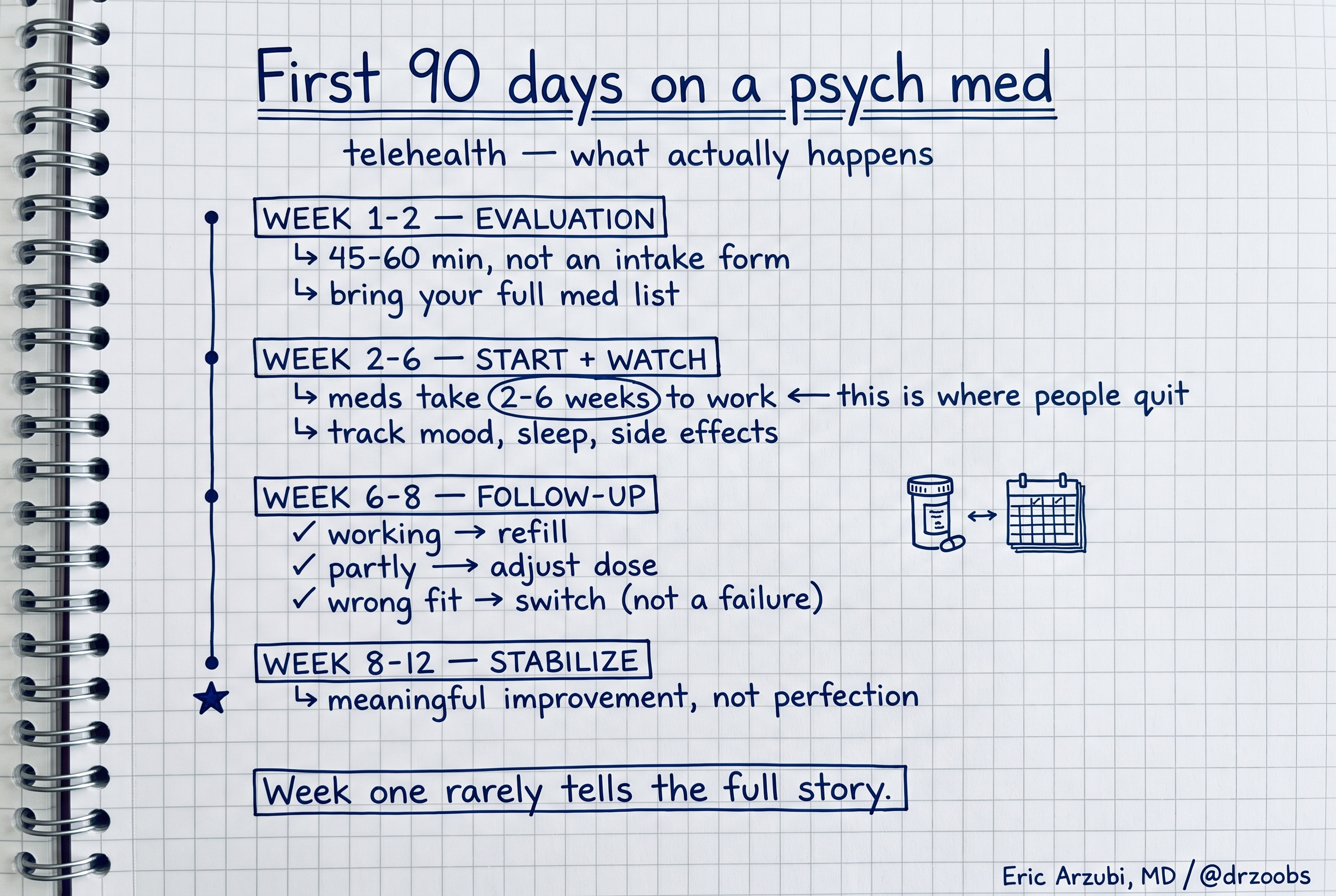
Psychiatric medication management isn't a single event. It's a process that unfolds over weeks, with each visit building on the last. Here's what that looks like, phase by phase.
Weeks 1-2: The evaluation
Your first visit with a Frontier provider runs 45 to 60 minutes. It's not a quick intake form. Your provider will ask about your current symptoms, your mental health history, your family history, every medication you're currently taking (including supplements and over-the-counter drugs), and what you're hoping treatment will do for you.
Come prepared. The more specific you can be, the better your provider can tailor the plan.
Medication is not the automatic outcome of a first visit. Frontier's approach is conservative and evidence-based. Your provider will talk through all options before recommending a prescription, and if medication is the right fit, you'll discuss which class, what to expect, and how to get it filled given where you live.
Weeks 2-6: Starting and watching
Most psychiatric medications take two to six weeks to reach their full effect. This is the part most patients don't know going in, and it's the part most likely to make someone give up too soon.
Not feeling dramatically different in week one is not a sign the medication is wrong. It's normal.
Track these things during this window:
- Mood and energy: Even small, early shifts matter. Note them.
- Sleep: Many psychiatric medications affect sleep in the first weeks before they stabilize.
- Side effects: Nausea, headache, and restlessness are common early and usually resolve. If they don't, contact your care team.
- Anything that feels wrong: Don't wait for your next visit. Use Frontier's patient portal to message your provider or the clinical pharmacist directly.
The portal isn't just for scheduling. It's how you stay connected between visits, which is especially important when your next appointment is a month out and you're in a community without urgent psychiatric care nearby.
Weeks 6-8: The first follow-up
Your first follow-up is typically four to six weeks after starting medication. This is where your provider assesses whether it's working, whether the dose is right, and whether you're tolerating it well.
Three things can happen at this visit:
It's working. Your provider continues the medication, sends a refill, and schedules the next check-in. Most patients land here.
It's partially working. Something is improving but not enough, or there are side effects that aren't resolving. Your provider may adjust the dose, add a complementary medication, or discuss a switch. The clinical pharmacist reviews any change against your full list before it goes out.
It's not the right fit. Some medications don't work for a given person. This is not a failure, and it doesn't mean medication won't work. It means you try a different one. Your provider will explain why and what comes next.
Weeks 8-12: Stabilization
By the end of the first 90 days, most patients on a well-matched medication are experiencing meaningful improvement. Not perfection. Meaningful improvement. The goal at this stage is stability: a medication that works, a dose that's right, a refill process that functions, and a plan for what comes next.
Your provider will review how your symptoms have changed, whether the medication is sustainable long-term, and whether adding therapy or other supports would help. The clinical pharmacist may conduct a more formal medication review at this point, especially for patients on multiple medications or anyone whose PCP has made changes to their non-psychiatric prescriptions during this period.
At 90 days, you and your provider will have enough information to make a confident decision about your ongoing care.
Getting Prescriptions Filled in Montana, Idaho, and Alaska
Telehealth solves the distance problem for visits. It doesn't automatically solve the pharmacy problem. Here's what patients in each state commonly deal with, and how Frontier's clinical pharmacist helps navigate it.
Montana
Patients in Billings, Missoula, Great Falls, and Bozeman generally have solid pharmacy access. Outside those cities, stock varies significantly. A small independent pharmacy in a rural county seat may not carry a less common medication, or may need several days to order it.
For patients in more remote areas, mail-order pharmacy through your insurance plan is often the most reliable option for maintenance medications. Your clinical pharmacist can help you figure out which path makes more sense before your first prescription goes out, not after you've driven 45 minutes to find out it's not in stock.
Idaho
The Treasure Valley (Boise, Nampa, Meridian) has strong pharmacy access. Northern Idaho, the Wood River Valley, and rural eastern Idaho face the same limited-stock challenges as rural Montana. If your nearest pharmacy isn't open 24 hours, plan refills at least a week in advance. Your Frontier team can help you build that lead time into your care plan.
Alaska
Alaska has the most variable pharmacy access of the three states. Anchorage and Fairbanks have full-service options. Patients in rural and bush communities may depend entirely on mail-order or periodic supply runs. For these patients, Frontier builds longer lead times into refill planning from the start. The clinical pharmacist coordinates with your pharmacy directly when supply issues arise, which in Alaska is not a rare occurrence.
What about controlled substances?
This is one of the most common questions Frontier gets, so it deserves a straight answer.
Federal rules govern how stimulants like Adderall and Vyvanse can be prescribed via telehealth. Those rules changed after COVID-era flexibilities ended. Frontier's providers follow the current DEA telehealth prescribing rules and will tell you plainly what's possible at your evaluation.
The practical breakdown:
Non-controlled psychiatric medications (SSRIs, SNRIs, mood stabilizers, non-stimulant ADHD medications like Strattera or Qelbree, most antipsychotics) can be prescribed and managed entirely via telehealth, no in-person visit required.
Stimulant medications for ADHD may require additional steps depending on current DEA rules and your state. Your provider will walk you through this at your evaluation.
Benzodiazepines are generally not prescribed by Frontier via telehealth for new patients, consistent with evidence-based guidelines around dependence risk. If you're currently on a benzodiazepine prescribed by another provider, your Frontier team will discuss the safest path forward.
Frontier's clinical pharmacist can advise on non-controlled alternatives when a controlled substance isn't accessible through telehealth. There are often good options that patients and providers overlook.
Working With Your Other Providers
Most Frontier patients already have a PCP or a therapist in their community. Frontier is built to work alongside them, not replace them.
With your written permission (a release of information, or ROI), Frontier will share your psychiatric evaluation and treatment plan with your PCP. Your team will also coordinate on medications that overlap with conditions your PCP manages, and keep your therapist informed so medication management and therapy stay aligned.
This matters more than it sounds. In rural communities, your PCP is often the only in-person provider you see regularly. They may be managing your blood pressure, your thyroid, and your chronic pain. All of those can have medication interactions with psychiatric medications. When Frontier's clinical pharmacist reviews your full list, they're looking at the whole picture, not just the psychiatric piece.
If you don't have a therapist, your Frontier provider can help you think through whether therapy would strengthen your treatment and how to find one in your area or via telehealth. Research consistently shows that medication combined with therapy produces better outcomes than either approach alone for most common conditions, including depression, anxiety, and PTSD.
When to get urgent help
Medication management via telehealth is right for stable and improving patients. If any of the following happen, don't wait for your next visit:
- Thoughts of harming yourself or others
- A sudden, severe worsening of mood or behavior
- Signs of serotonin syndrome after starting or increasing a medication: agitation, rapid heart rate, high temperature, muscle twitching
- Any medication reaction that feels medically urgent
Call 988 (Suicide and Crisis Lifeline), text HOME to 741-741 (Crisis Text Line), or go to your nearest emergency room. Frontier's providers will always tell you plainly when in-person or emergency care is the right level, not telehealth.
Common Questions
How many visits will I have in the first 90 days?
Most patients have two to three: the evaluation, a follow-up at four to six weeks, and a 90-day check-in. After stabilization, many move to quarterly visits. Your provider will recommend a schedule based on your specific situation.
What if I have a medication question between visits?
Use Frontier's patient portal to message your care team. For medication-specific questions, the clinical pharmacist can respond directly. You don't have to wait for a scheduled visit, and you shouldn't.
I'm already on a medication my PCP prescribed. Can Frontier take it over?
Yes. Frontier providers regularly continue medications prescribed by a PCP. The clinical pharmacist will review the current medication, dose, and formulation before your provider takes over management.
Can a telehealth provider prescribe my medication to a pharmacy in a small town?
Yes. Frontier sends prescriptions electronically to the pharmacy of your choice. If your local pharmacy has stock or ordering limitations, the clinical pharmacist can help identify alternatives, including mail-order, before you hit a wall.
Is my medication information private?
Yes. Frontier is fully HIPAA-compliant. Your medication records are not shared with anyone outside your care team without your written permission. That includes your employer, family members, and other providers unless you specifically authorize it. In small communities, where everyone knows your truck, that matters.
What if my insurance changes?
Frontier accepts most major insurance plans across Montana, Idaho, and Alaska, including Medicaid, Medicare, Blue Cross Blue Shield, and UnitedHealthcare. You can check your eligibility online before your first visit. If your coverage changes, contact Frontier's team before your next visit. Your care won't be interrupted without a conversation.
Ready When You Are
Frontier Psychiatry serves patients across all 56 Montana counties, Idaho, and Alaska. No referral needed. Most insurance accepted. New patients are typically matched with a provider and seen within 10 days.
Key Takeaways
- The first 90 days usually include an evaluation, a follow-up at four to six weeks, and a 90-day check-in.
- Most psychiatric medications take two to six weeks to work, so week one rarely tells the full story.
- Frontier's clinical pharmacist helps with interactions, refills, and pharmacy coordination, which matters more in rural Montana, Idaho, and Alaska.
- If something feels off between visits, message your care team instead of waiting it out.
Across more than 160 Google reviews in three states, Frontier holds a 4.3-star average. The most common thing patients say: they finally feel like someone is actually paying attention.
Get started at frontier.care or call (406) 200-8471.
If you're a primary care provider or therapist looking to refer a patient, visit frontier.care/refer.
Not sure which type of provider you need, or how a psychiatrist differs from a PCP or NP when it comes to prescribing? Here's what the first 90 days of psychiatric medication usually look like and how provider roles fit into that picture.
ByEric Arzubi, MD, Assistant Clinical Professor at the Yale School of Medicine; CEO and Co-Founder of Frontier Psychiatry