

How to Help Someone with Depression (Even When They Pull Away)
By Eric Arzubi, MD, Assistant Clinical Professor at the Yale School of Medicine; CEO and Co-Founder of Frontier Psychiatry
You already know something is wrong. Maybe they stopped showing up to things they used to love. Maybe they're sleeping through the weekend or snapping at everyone and then going quiet for days. Maybe you asked if they were okay and they said "I'm fine" in a way that meant the opposite.
Watching someone you care about struggle with depression is one of the hardest things there is. It's harder when they're pulling away, refusing help, or insisting they're fine. You want to do something but don't know what. You're afraid of saying the wrong thing and pushing them further away.
This guide is for you. Not a clinical overview of what depression is. A practical answer to the question you're actually asking: what do I do, right now, to help someone I love who is depressed?
The short answer: Keep showing up, even when they push you away. Say less than you think you should. And know when to bring in a professional. The rest of this guide explains exactly how to do all three.
What Depression Actually Looks Like From the Outside
Most people picture depression as someone who cries all the time and can't get out of bed. That happens. But it often looks different, especially in men, in people who pride themselves on being tough, and in communities where struggling quietly is the norm.
In Alaska, Idaho, and Montana, people are used to pushing through hard things. That same instinct can make depression nearly invisible to everyone around them, including themselves.
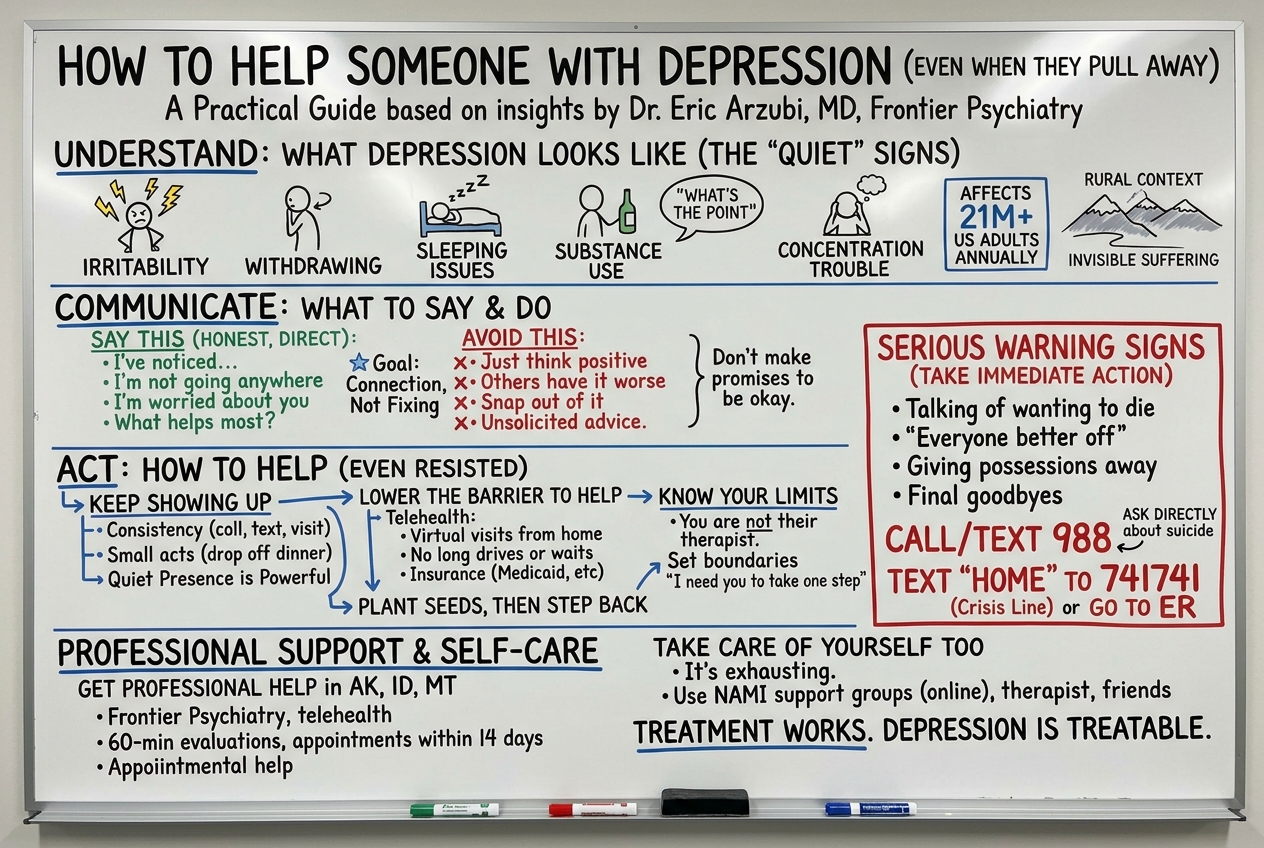
Signs that are easy to miss:
- Irritability, short temper, or a short fuse that wasn't there before
- Withdrawing from people they used to want to be around
- Losing interest in work, hobbies, or things they were previously good at
- Sleeping too much or too little, often with no explanation
- Drinking more than usual, or using substances to get through the day
- Saying things like "what's the point" or "I'm just tired" more than once
- Moving or speaking more slowly than normal
- Trouble concentrating or making decisions they used to handle easily
None of these alone confirms depression. But a cluster of them, lasting more than two weeks, is worth taking seriously. According to the National Institute of Mental Health, depression affects more than 21 million adults in the United States each year. Most of them don't get treatment.
That gap between suffering and getting help is exactly where you can make a difference.
What to Say (and What Not to Say)
Most people freeze because they're afraid of saying the wrong thing. That fear makes sense. But silence, or pretending nothing is wrong, is usually worse than an imperfect conversation.
What actually helps
You don't need a script. You need to be direct, honest, and present. Some phrases that work:
- "I've noticed you seem different lately. I'm not going anywhere."
- "You don't have to explain anything. I just want you to know I'm here."
- "I'm worried about you. Can we talk?"
- "What would help you most right now?"
The goal is not to fix them. The goal is to make them feel less alone. Depression lies. It tells people nobody cares, that they're a burden, that nothing will get better. Your job is to contradict that lie with your presence and your honesty.
What tends to backfire
Some things feel helpful but aren't. Avoid these:
- "Just think positive." Depression is not a bad attitude. Saying this just minimizes what they're going through.
- "Other people have it worse." Comparison doesn't reduce suffering. It just adds shame.
- "You have so much to be grateful for." True, and irrelevant to what they're experiencing.
- "Snap out of it" or "push through it." If they could, they would.
- Unsolicited advice. Unless they ask, hold it. Right now they need to feel heard, not coached.
One more thing: don't make them promise to be okay. That puts the burden of your anxiety onto them. Instead, make it clear that you can handle the truth, whatever it is. If you want a clearer map of depression itself before you have that conversation, our understanding depression guide is a useful starting point.
How to Help Someone with Depression Who Doesn't Want Help
This is the hardest part. You can see what's happening. They can't, or won't. They say they're fine. They get angry when you bring it up. They tell you to back off.
You can't force someone to get help. But you're not powerless either.
Keep showing up anyway
Consistency matters more than any single conversation. People in the middle of depression often pull away not because they don't want connection. They pull away because they're convinced they don't deserve it. Keep calling. Keep checking in. Keep being the person who doesn't disappear.
You don't have to talk about depression every time. Sometimes showing up means dropping off dinner, texting to say you're thinking of them, or sitting with them without an agenda. In small towns especially, that kind of quiet presence gets noticed. Presence is not nothing. It is often everything.
Lower the barrier to help
One of the biggest reasons people don't get psychiatric care in rural Alaska, Idaho, and Montana is logistics. The nearest provider is hours away. The waitlist is months long. A day off work to drive to a city isn't realistic for most people.
Telehealth changes that. A visit with a psychiatric provider can happen from their kitchen, their truck, or their back porch. No referral needed. Most insurance accepted, including Medicaid. Appointments are usually available within two weeks.
When you bring up getting help, be specific. "There's a place you can see someone over video from home. I can help you set it up" lands differently than "you should talk to someone."
Plant seeds, then step back
You may not be the one who gets them to say yes. That's okay. Your job is to make getting help feel normal and possible, not to force a decision. Say your piece, make it clear you're not going anywhere, then give them space. Sometimes it takes weeks. Sometimes months. But the people who keep showing up are usually the reason someone finally reaches out.
Know your limits
You are not their therapist. You are not responsible for their recovery. Carrying that weight alone will wear you down, and a depleted caregiver is less able to help. It is not abandonment to say: "I love you and I can't keep doing this alone. I need you to take one step toward getting help."
That's not an ultimatum. That's honesty. And it sometimes works when everything else hasn't.
When to Take It More Seriously
Most people with depression are not in immediate danger. But some are. Knowing the difference matters.
Get help right away if they:
- Talk about wanting to die or not wanting to be here anymore
- Say things like "everyone would be better off without me"
- Give away meaningful possessions
- Say goodbye in a way that feels final
- Have a plan or access to means to hurt themselves
If any of these are happening, don't wait. Stay with them if you can. Call or text 988 (the Suicide and Crisis Lifeline) together, or take them to the nearest emergency room. You can also text HOME to 741-741 (Crisis Text Line) if calling feels like too much.
Asking someone directly if they're thinking about suicide does not plant the idea. Research consistently shows the opposite: asking directly often brings relief and opens a door that was shut. If you're worried, ask.
"Are you thinking about hurting yourself or ending your life?"
Say it plainly. Then listen.
Should They See a Psychiatrist or a Psychologist?
This question comes up a lot, and the confusion is understandable. Here's the practical difference:
For someone with depression, the answer often isn't either/or. Many people do best with both: a psychiatric provider managing medication and a therapist doing the talk work. If you're still trying to sort out whether this is depression, stress, or something else, our Am I depressed? guide walks through the signs in plain language.
If they've been struggling for more than a few weeks and it's affecting their daily life, start with a psychiatric evaluation. A good psychiatrist or psychiatric nurse practitioner will assess the full picture, rule out other causes, and talk through all the options, including whether medication makes sense.
At Frontier Psychiatry, initial evaluations are 60 minutes. That's enough time to actually understand what someone is going through, not just hand them a prescription and move on.
Take Care of Yourself Too
Supporting someone with depression is exhausting. That's not a complaint, it's a fact. And if you're running on empty, you're less able to show up for them.
You're allowed to have your own feelings about this. Fear, frustration, grief, helplessness. Those are normal responses to watching someone you love suffer. Find somewhere to put them, whether that's a trusted friend, your own therapist, or a support group for family members of people with mental illness.
NAMI (the National Alliance on Mental Illness) offers free support groups for family members and caregivers. If you're in a small town in Montana, Idaho, or Alaska with no local groups nearby, their online options work from anywhere with a decent connection. You don't have to be in crisis to use them, and you don't have to explain your whole situation to a room full of strangers. You just have to show up.
Taking care of yourself is not selfish. It is how you stay in this for the long haul.
Getting Professional Help in Alaska, Idaho, and Montana
Finding a psychiatrist in rural AK, ID, or MT used to mean a long drive, a long wait, or giving up. That's changed.
Frontier Psychiatry is a telepsychiatry practice built specifically for people in these states. Every visit is virtual, meaning the person you're worried about can be seen from home, no referral required, no long waitlist, no three-hour drive.
What to expect:
- Initial evaluations are 60 minutes, a real conversation, not a rushed intake
- Follow-up visits are at least 30 minutes every time
- Appointments are typically available within 14 days
- Medicaid, Medicare, Blue Cross Blue Shield, and most major insurers are accepted
If you want to help someone take that first step, you can offer to sit with them while they book, help them figure out their insurance, or simply send them the link. Sometimes the smallest logistical help is what gets someone through the door.
Learn more or schedule a visit at Frontier Psychiatry.
Key Takeaways
- Show up consistently. Depression tells people nobody cares. Your presence contradicts that.
- Say something, even if it's imperfect. Silence is usually worse than an awkward conversation.
- Lower the logistical barrier. Offer to help them book, not just tell them to go.
- Know when to escalate. If they're talking about death or giving things away, call 988 or go to the ER.
- You can't do this alone. Take care of yourself, or you won't be able to take care of them.
- Treatment works. Depression is one of the most treatable conditions in psychiatry. The hard part is getting someone to that first appointment.