

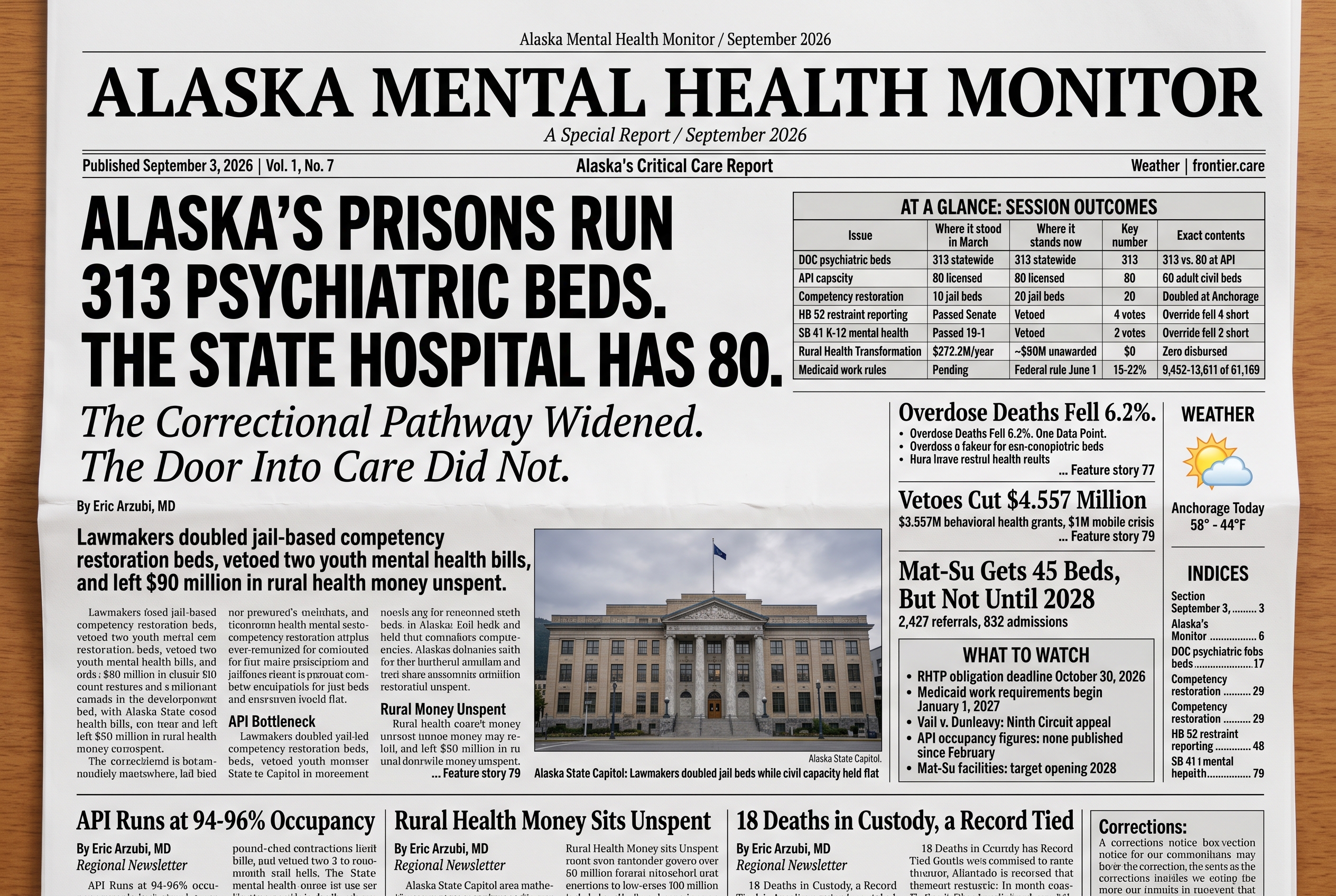
Alaska's Prisons Run 313 Psychiatric Beds. The State Hospital Has 80.
Covering March 1 to August 30, 2026. Published September 3, 2026.
By Eric Arzubi, MD, CEO and Co-Founder, Frontier Psychiatry. Assistant Clinical Professor, Yale Child Study Center.
Alaska's Department of Corrections operates two acute inpatient psychiatric units and five subacute units, 313 beds systemwide. The Alaska Psychiatric Institute, the state's only state-run psychiatric hospital, is licensed for 80. The department's own health and rehabilitation director has told legislators that DOC is "one of the largest behavioral health care providers in the state."
The correctional side kept growing this year. Alaska doubled jail-based competency restoration beds at the Anchorage Correctional Complex from 10 to 20 and extended the program to Hiland Mountain, the state's only all-female facility. Over the same months, Gov. Mike Dunleavy vetoed two youth mental health bills that had passed both chambers with bipartisan majorities, and both override attempts failed. In the fiscal 2026 budget he vetoed $3.557 million from behavioral health treatment and recovery grants and another $1 million from mobile crisis funding.
At the state hospital, about 30 patients found incompetent to stand trial occupied roughly half of the 60 adult civil beds as of a February legislative hearing, because no community placement exists for them. Adult occupancy was running 94% to 96%.
The picture is not uniformly grim. Two youth mental health facilities are under construction in the Mat-Su Valley, together worth $93 million to $98 million, and the state has committed federal rural health money across about 185 projects. But the correctional pathway keeps getting wider while the civil one stays narrow, and that is the through-line of Alaska's year.
This edition resolves the four questions left open in our March 2026 monitor and reports four developments that followed.
At a Glance
The Corrections Department Is Alaska's Largest Psychiatric Provider
Lawmakers advanced an all-time-high $523 million Department of Corrections budget for fiscal 2027 in March. The department's health care spending grew from $31.5 million to $62.2 million between 2012 and 2023. Commissioner Jen Winkelman told legislators that a single inmate's medical costs exceeded $1 million in one year, an unplanned expense the department absorbed.
Roughly 4,300 Alaskans are in DOC custody on an average day. The department reports that 75% are mental health trust beneficiaries or carry a substance use diagnosis.
Alaska tied its record of 18 in-custody deaths in 2025. A fourth death of 2026 was reported July 10, when Brandon Kalief Wright, 31, died at the Anchorage Correctional Complex. In March, a state investigation found asphyxia was the primary factor in the July 2025 death of Jeffrey Foreman, who was experiencing a mental health crisis when correctional officers restrained him. Prosecutors declined to file charges.
The ACLU of Alaska's class action, Vail v. Dunleavy, argues the resulting care is unconstitutionally inadequate. Filed May 1, 2025, it survived a motion to dismiss on December 30. The state appealed to the Ninth Circuit on January 28, and the case is pending with no trial date set.
On August 22, attorney Lacey Jane Brewster argued in the Anchorage Daily News that Alaska's 40-year-old "guilty but mentally ill" verdict routes people who belong in a hospital into jail instead, and called on the Legislature to repeal it.
Half of API's Adult Beds Are Held by Patients Who Can't Be Discharged
Alaska Psychiatric Institute CEO Ken Cole told a legislative hearing on February 5 that "conversion patients," people found incompetent to face criminal charges who remain under civil commitment because no community placement exists, numbered about 30. They occupied roughly half of the hospital's 60 adult civil beds. Overall adult occupancy was running 94% to 96%.
The arithmetic is straightforward. A hospital with 60 adult beds that cannot discharge 30 of them is operating as a 30-bed hospital with a waitlist.
API's total licensed capacity is 80 beds: 60 adult, 10 adolescent, and 10 forensic. Its 10-bed Taku competency restoration unit has historically run near capacity at 47 to 50 admissions a year.
The budget cuts both ways. API's operating budget runs $64 million to $66 million a year, and the hospital says better billing raised revenue collection by roughly $5 million this fiscal year over last. But Dunleavy vetoed $3.557 million from behavioral health treatment and recovery grants against a $45.5 million base, plus a separate $1 million from Crisis Now mobile crisis grants. Those cuts could constrain the community step-down placements Cole says API needs to relieve bed pressure.
The state's response to the bottleneck was to double jail-based restoration capacity rather than build community placements.
No updated census or waitlist figures have been published since the February 5 hearing. A July legislative recap by the law firm Schwabe identifies no bill or appropriation targeting the conversion-patient bottleneck.
Dunleavy Vetoed Two Youth Mental Health Bills and Both Overrides Failed
Dunleavy vetoed House Bill 52 and Senate Bill 41 on June 18. Neither override succeeded.
House Bill 52 would have required Alaska psychiatric hospitals, including North Star Behavioral Health and API, to notify parents and the state within one business day of restraining or secluding a minor, publish annual restraint data, and undergo twice-yearly unannounced inspections. It passed the Senate unanimously. The override attempt fell 36-24 on June 19, four votes short of the two-thirds threshold.
Senate Bill 41 would have directed the state Board of Education to create statewide K-12 mental health education guidelines. It passed the Senate 19-1 and the House 27-13. Its override fell 38-22, two votes short.
Dunleavy's veto letters said HB 52 "adds duplicative inspection, reporting, and notification requirements" beyond existing licensing and accreditation standards, and that SB 41 improperly placed curriculum decisions with the state rather than "parents, local school boards, and communities."
Fiscal notes for both bills were mostly listed as zero-impact by the affected agencies. No statewide compliance cost estimate has been located for either.
Sponsor Rep. Maxine Dibert said the veto meant "another year of hardship on families and youth who are not getting the oversight that they deserve." SB 41 sponsor Sen. Elvi Gray-Jackson called the sustained veto a failure on "more than just youth mental health policy."
Both bills are dead for this Legislature. Dibert plans to reintroduce hers when the 35th Legislature convenes in January.
Mat-Su Regional Medical Center Is Building 45 Psychiatric Beds
Two youth mental health facilities are under construction in the Mat-Su Valley, aiming to keep young Alaskans out of Anchorage and out-of-state placements.
Mat-Su Regional Medical Center's new freestanding psychiatric hospital will raise the region's inpatient capacity from 16 beds to 45, split between 27 adult and 18 adolescent. The state approved its Certificate of Need in mid-February. Construction is under way with no reported delays and a 2028 target opening.
The need is documented in the hospital's own numbers. MSRMC handled 2,427 behavioral health referrals across 2024 and 2025 and admitted only 832 patients for lack of beds. When the existing 16-bed unit fills, patients are transferred to Anchorage or out of state.
Total project cost has been reported inconsistently. The hospital's original 2025 filing and a July 2025 trade report cited $75 million. The state's February Certificate of Need notice lists $72.5 million. MSRMC's own announcement cites $70 million.
Separately, MY House's Carson-Cottle Center in Wasilla carries a consistently reported $23 million price tag, funded primarily through a 2022 federal appropriation plus a $4.38 million grant from the Mat-Su Health Foundation. It broke ground around June and targets a December opening. Tariff-driven steel costs forced the footprint down from 45,000 to 33,000 square feet.
Once open, it will grow MY House's system capacity from about 50 beds to about 110, serving homeless and at-risk youth ages 14 to 25. An estimated 230 youth are unhoused in the Mat-Su area at any given time.
Alaska Has Committed Most of Its Rural Health Money and Disbursed None of It
Alaska's Rural Health Transformation Program award runs $272.2 million a year for five years. The Department of Health issued its first notices of intent to award on August 7 and had committed roughly $160.7 million, about 59% of the year-one allocation, across 161 projects by August 21. A fourth weekly round on August 28 added $16.8 million across 24 more projects, for about 185 projects in total and roughly $90 million of the year-one allocation still unawarded.
No money has been disbursed as cash. Grant agreements are still being executed. The federal obligation deadline is October 30.
The pace was not always this fast. The Anchorage Daily News reported on August 7 that the state initially awarded less than 2% of the funding before accelerating.
Behavioral health projects in the award list through August 21 total roughly $22 million, including a $5 million Ketchikan Indian Community crisis center and a $3.02 million Anchorage crisis-connectivity project. The state does not publish a behavioral health subtotal, and it has not released a dollar breakdown for the August 28 round.
Alaska's Medicaid Work Requirements Start January 1, and the Rules Are No Longer Alaska's
The state was drafting its own definitions for "medically frail" exemptions. A federal interim final rule issued June 1 overtook that work, imposing a stricter uniform national test and barring states from adding their own exemption categories.
Alaska is not among the 25 states suing over the rule. No state-specific delay or waiver has been confirmed. January 1, 2027 remains the operative deadline.
Coverage-loss estimates have not been updated since February, when a state-commissioned analysis projected that 9,452 to 13,611 of 61,169 expansion enrollees could lose coverage. That is roughly 15% to 22% of the expansion population.
No Minor Consent Law Exists in Alaska
None of the three bills tracked in March created one.
House Bill 36 became law on June 22, but the minor consent language it briefly carried was stripped in Senate Finance before final passage. The law as enacted deals only with foster care psychiatric placement procedures.
Senate Bill 90 and House Bill 232, which kept the consent language, both died in their chambers' Rules committees and cannot be revived. They would need to be reintroduced from scratch in January.
Overdose Deaths Returned to Decline
Alaska appeared on the CDC's list of states with rising overdose deaths for the first time, up 1.23% for the 12 months ending January 2026. The next monthly release showed the state back to a 6.2% decline for the 12 months ending February, the most recent state-level data available.
One month is not a trend in either direction.
What to Watch
October 30, 2026. Federal deadline to obligate year-one Rural Health Transformation Program funds. Roughly $90 million, about a third of the allocation, was still unawarded as of August 28.
December 2026. MY House's Carson-Cottle Center targeted opening in Wasilla.
January 1, 2027. Alaska's Medicaid work and community engagement requirements take effect. Watch for any state delay request or an updated coverage-loss estimate before then.
January 2027. The 35th Legislature convenes. Watch for reintroduction of minor consent legislation, HB 52 on restraint reporting, and SB 41 on K-12 mental health education.
2028. Targeted opening of Mat-Su Regional Medical Center's 45-bed psychiatric hospital.
No date set. A Ninth Circuit ruling on the state's appeal in Vail v. Dunleavy, and any updated API census or waitlist figures beyond the February 5 hearing.
My Take
Start with the two numbers and sit with them for a second. Three hundred thirteen psychiatric beds in Alaska's prisons. Eighty in the state hospital. The Department of Corrections is not accidentally in the mental health business. Its own health and rehabilitation director says so out loud to legislators.
I have spent a decade building psychiatric services in Alaska and the other two states in this series, and I want to be careful here, because the people running DOC did not ask for this. They inherited it. When a state does not build community capacity, the jail becomes the placement of last resort, and then the placement of first resort, and eventually the largest provider in the state. That is what 313 beds means.
Look at what happened at API this year and you can see the mechanism working. As of February, about 30 people found incompetent to stand trial were sitting in half the hospital's adult beds, not because they needed hospital care, but because there was nowhere to discharge them. The state's answer was to double competency restoration beds inside the Anchorage jail. That is a rational response to the immediate bottleneck and it makes the underlying problem worse, because the thing Alaska is short of is community placements, and the state vetoed $3.6 million of the grants that fund them plus another $1 million for mobile crisis.
Then the two vetoes. HB 52 asked psychiatric hospitals to tell a parent within one business day when their child had been restrained. It passed the Senate unanimously. Not narrowly. Unanimously. The override still failed by four votes. I have restrained children in a hospital. It is sometimes necessary and it is always serious, and a parent finding out the next day is the floor, not a burden.
The Mat-Su projects are real and I do not want to bury them. Forty-five beds where there were 16, and a youth center opening in December. That is the right direction. But 2028 is a long way from a family in Wasilla whose kid needs a bed this winter, and 2,427 referrals against 832 admissions tells you what the wait looks like right now.
Alaska keeps widening the door into the correctional system and leaving the door into care about the same size. You can predict the rest.
If you or someone in your family needs psychiatric care in Alaska, Frontier Psychiatry provides child and adolescent psychiatry and adult psychiatric care statewide by telehealth. No referral needed. Check your insurance in under a minute.
If you are in crisis, call or text 988.
Updates and Clarifications to the March 2026 Edition
Our March edition tracked three bills that could have established a minor consent law in Alaska. None did. House Bill 36 became law on June 22, but its minor consent language was removed in Senate Finance. Senate Bill 90 and House Bill 232 died in Rules. Alaska has no minor consent law as of this writing.
We reported that Alaska was drafting its own rules defining "medically frail" exemptions for Medicaid work requirements. A federal interim final rule issued June 1 supersedes that work and bars states from adding exemption categories.
We noted Alaska's first appearance on the CDC's rising overdose deaths list. That increase covered a single 12-month window and reversed in the following monthly release.
Last updated September 3, 2026. How we compile the Monitor. Corrections policy.
Sources
Corrections and Vail v. Dunleavy
Primary documents
- Civil Rights Litigation Clearinghouse, Vail v. Dunleavy docket
- ACLU of Alaska, Vail v. Dunleavy case page
- Alaska Legislature, "Prison Programs" document
- Alaska OMB, FY2025 Governor's Operating Budget, Department of Corrections
News coverage
- Alaska Beacon, "Alaska lawmakers advance all-time high $523M Department of Corrections budget," March 10, 2026
- Corrections1, "Overtime, healthcare fuel sharp rise in Alaska corrections spending," February 27, 2026
- Alaska Public Media, "Jailed Anchorage man is fourth to die in custody so far in 2026," July 10, 2026
- Anchorage Daily News, "Man died of asphyxia while being restrained by Anchorage jail officers, state finds," March 26, 2026
- Anchorage Daily News, "Opinion: Forty years of punishing mental illness is enough," August 22, 2026
Alaska Psychiatric Institute
Primary documents
- Summary of the February 5, 2026 legislative hearing on API
- Alaska OMB, FY2027 Governor's Operating Budget, API component
- Alaska Legislative Finance Division, FY2026 HSS Transaction Compare
- DFCS, Forensic Psychiatric Hospital Feasibility Study Executive Summary
News coverage
- Schwabe, "Alaska Healthcare Legislative Recap 2026," July 16, 2026
Youth Mental Health Vetoes
Primary documents
- Alaska Legislature, HB 52 bill history
- Alaska Legislature, SB 41 bill history
- Governor Dunleavy, veto letter, HB 52, June 18, 2026
- Governor Dunleavy, veto letter, SB 41, June 18, 2026
News coverage
- Alaska Public Media, "Bill to protect youth in psychiatric hospitals dies after Dunleavy veto," June 24, 2026
- Mother Jones, "A Mother Jones Investigation Helped Spur a New Alaska Law Protecting Vulnerable Kids," June 23, 2026
- Alaska Native News, "Legislature Sustains Veto of Critical Youth Mental Health Bill," June 27, 2026
Mat-Su Facilities
Primary documents
- Alaska Department of Health, Certificate of Need approval notice, February 17, 2026
- Mat-Su Regional Medical Center press release, February 19, 2026
News coverage
- Alaska Public Media, "Two major projects could reshape mental health care for Mat-Su youth," August 3, 2026
- Mat-Su Sentinel, August 6, 2026
- Frontiersman, "Homeless youth facility expanding to meet demand for services," June 2, 2026
Rural Health Transformation Program
Primary documents
- Alaska Department of Health, RHTP program page
- Alaska DOH, RHTP Year 1 Funding Cycle Update, August 21, 2026
- Alaska DOH, RHTP award-notice spreadsheet, August 21, 2026
News coverage
- Anchorage Daily News, "Alaska officials award less than 2% of rural healthcare funding, postponing decision on remainder," August 7, 2026
- Rural Care Journey funding tracker, RHTP activity feed, August 28-29, 2026
Medicaid Work Requirements
Primary documents
- Alaska DOH, Medicaid work and community engagement requirements page
- Alaska DOH / Manatt Health modeling report, February 2026
- CMS, nationwide Medicaid work requirements framework press release, June 11, 2026
News coverage
- Ballotpedia, "CMS releases interim final rule for Medicaid work requirements, defines medical frailty exempt," June 12, 2026
Minor Consent Bills
Primary documents
- Alaska Legislature, HB 36 bill history
- Alaska Legislature, SB 90 bill history
- Alaska Legislature, HB 232 bill history
Overdose Data
Primary documents
- CDC, Vital Statistics Rapid Release: Provisional Drug Overdose Data
News coverage
- Filter Magazine, "Overdose Data Show Two Paths Within Western Corridor of Rising Deaths," July 20, 2026
The Alaska Mental Health Monitor is compiled monthly by Frontier Psychiatry from primary state and federal records, supplemented by Alaska news coverage. Reporting is separated from analysis. Corrections are published in the edition following the error and noted permanently on the original.