

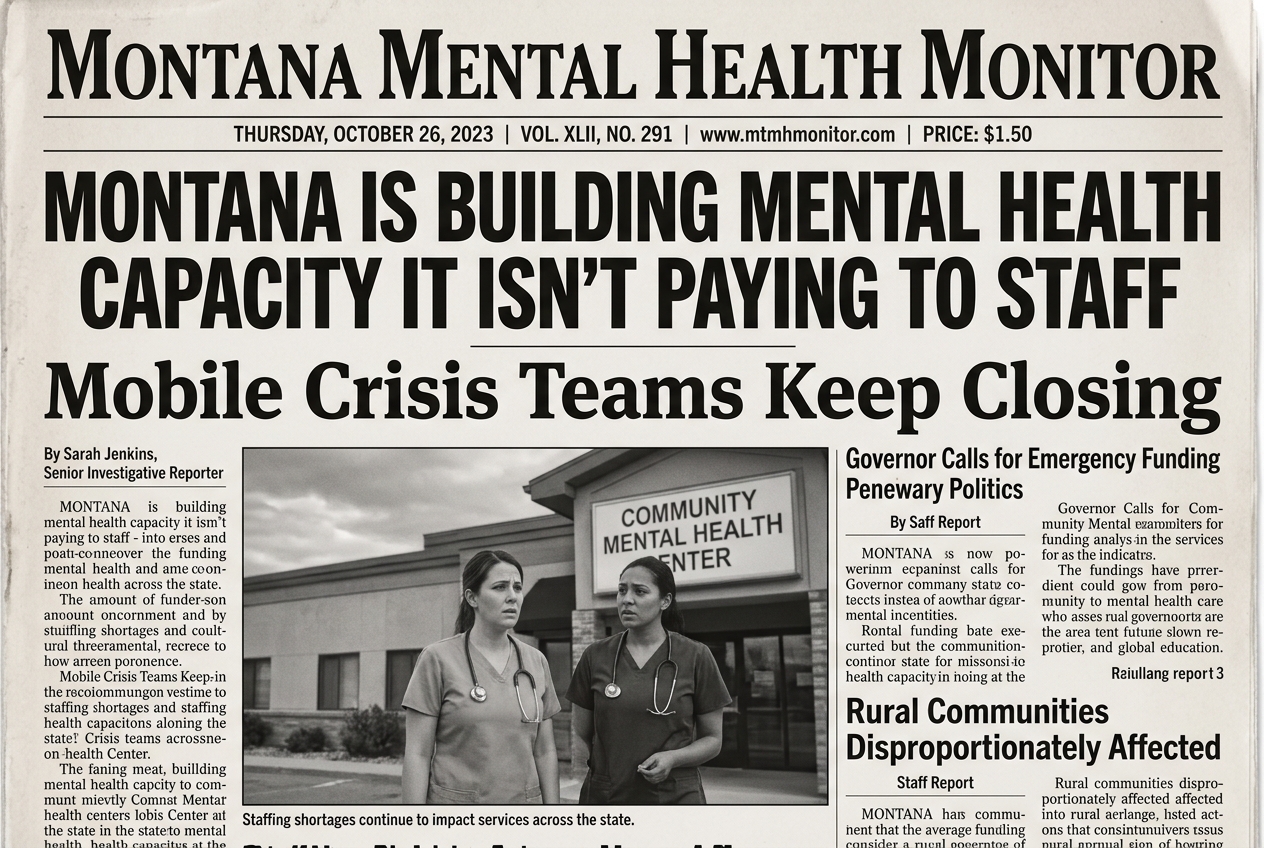
Montana Is Building Mental Health Capacity It Isn't Paying to Staff
Covering March 1 to August 30, 2026. Published August 30, 2026.
By Eric Arzubi, MD, Assistant Clinical Professor at the Yale School of Medicine; CEO and Co-Founder of Frontier Psychiatry
Montana spent the summer announcing new behavioral health capacity. It funded 20 more youth psychiatric beds, won a federal program that will pay clinics through Medicaid instead of grants, and bought land for a forensic hospital now estimated to cost as much as $48.3 million.
In the same months, the state declined to pay for the people who would staff any of it. On May 29, the Department of Public Health and Human Services confirmed it would not implement a 3% Medicaid rate increase the legislature had already approved, keeping roughly $10 million out of provider budgets. It cited a budget shortfall approaching $200 million.
Much of the building money is one-time. The youth bed grants come from the $123 million behavioral health package the 2025 Legislature approved, itself part of a larger $300 million effort created by House Bill 872 in 2023. A rate increase is recurring, and recurring money is what the state says it does not have.
The effect is already visible in the one service that has to show up in person. Montana's mobile crisis network has shrunk to about six operating teams, down from the eight the state moved onto Medicaid billing in January 2024.
Nearly every decision in this edition was made by the executive branch rather than the legislature, which is meeting only in interim committees this year. That matters for accountability. There is no floor vote to watch and no roll call to read. Instead, readers have to track agency notices, rule filings, and committee meetings. In two cases this year, the materials were never posted.
This edition resolves the four items left open in our March 2026 monitor and reports four developments that followed.
At a Glance
The Raise the Legislature Approved and the State Didn't Pay
State's Rationale for Withholding Funds
Montana providers will not get the 3% Medicaid rate increase lawmakers approved in 2025. DPHHS confirmed the decision in a May 29 provider notice, citing a budget shortfall approaching $200 million.
The department does not describe this as a cut. "DPHHS is not implementing a second year of provider rate adjustments due to the Legislature not adopting the Department's request for Medicaid funding during the 2025 session," it said in a statement.
Impact on Providers and Patients
The providers affected are the backbone of the system: 61 licensed mental health centers, 75 chemical dependency clinics, and more than 1,400 licensed clinical professional counselors bill Montana Medicaid for these services. Of Montana's Medicaid population, 83,055 members, or 36%, carry a mental health or substance use diagnosis.
Helena child psychiatrist Dr. Heather Zaluski described the effect in practical terms: "Children are currently waiting a year and a half to two years to have a needed evaluation. Without a rate increase, that wait will get longer and the number of providers that accept Medicaid will go down."
The state did finalize a separate rate rule on August 21, retroactive to October 1, 2025. It contains no general increase. It sets a $17.01 rate per 15-minute unit for a new case management benefit, and adopts two new case management benefits serving people leaving Montana State Prison and other facilities, together projected to cost about $241,000 in combined state and federal funds by their second year.
Mobile Crisis Teams Keep Closing
Montana's mobile crisis network is down to roughly six operating teams after programs in Great Falls and Billings shut down. The state had moved eight teams onto Medicaid billing in January 2024.
The billing model is the problem. Montana Medicaid pays only for the time a team spends actively responding to a call. It does not pay for documentation or for standby time. Missoula's team costs about $1.4 million a year. Medicaid covers roughly 20% of that, leaving a $250,000 annual shortfall even with local tax support.
The state put up to $8 million in one-time grants behind the transition in January 2024, an average of $437,500 per program, plus $2 million a year in supplemental funding. Program managers say the paperwork required to draw on the supplemental money often is not worth the staff time.
Montanans made more than 24,000 calls to the 988 line in 2025. Active mobile crisis teams currently reach 15 communities. No source publishes a count of how many counties have no coverage at all.
"A much-needed service is available and then not available, available and then not available," said Sierra Riesberg, director of the Behavioral Health Alliance of Montana.
Not every trend runs one direction. Helena's team expanded to 24-hour coverage by July 20, and Park County launched a new team in October 2025.
A New Clinic Model Launches October 1. The Rule Setting Payment Rates Hasn't Been Filed.
Montana is one of ten states newly selected for the federal Certified Community Behavioral Health Clinic Medicaid Demonstration, a four-year program that pays certified clinics cost-based Medicaid rates instead of short-term grants.
DPHHS projects the program will draw about $31.9 million in federal Medicaid funds and $8.4 million in state funds in its first year, rising above $42 million in federal funds annually by fiscal 2028. The department estimates about 7,155 Montanans will receive services, generating close to 239,000 billed visits a year across four certified providers operating roughly 20 sites.
DPHHS has not named the four providers.
"By establishing a sustainable, long-term payment system, we are eliminating the uncertainty of time-limited grants," Gov. Greg Gianforte said when the selection was announced May 29. DPHHS Director Charlie Brereton called it "another major milestone" in the state's behavioral health overhaul.
Services are set to begin October 1 under House Bill 574, passed in 2025. As of this writing, six weeks out, DPHHS has not proposed or adopted the rule needed to certify clinics and set their payment rates. No Medicaid state plan amendment for the new payment system has been posted for public comment. The department's own target was to file those rules by July 1.
The launch date is six weeks away and the mechanism that makes it work does not yet exist on paper.
$1.2 Million for 20 Beds, While 263 Montana Kids Go Out of State
Gianforte and DPHHS announced $1,237,000 on May 18 for Montana's only two youth psychiatric residential treatment providers, Shodair Children's Hospital and Yellowstone Boys and Girls Ranch. The money is split into two grants of $618,500 each.
Program rules require each provider to add at least 10 new Medicaid or Healthy Montana Kids beds, so the grants fund a floor of 20 beds combined. Neither the governor's release nor the DPHHS announcement states a bed count.
The need is documented. In the fiscal year that ended June 30, 2025, 194 Montana youth were placed in out-of-state psychiatric residential facilities and 69 more in out-of-state group homes, a combined 263 children sent away for care.
Yellowstone Boys and Girls Ranch receives about 150 referrals a month and can serve 15 to 20 of those children.
"Today, we're serving more kids in the state of Montana than we ever had before, which is great news," CEO Mike Chavers said. "But we're also at the same time sending more kids out of state than we ever have before."
In-state psychiatric residential treatment grew 41% in 2025. Grant funds must be spent by June 30, 2028, and each provider must show a 90-day increase in children served before receiving final payment. No update has been published on whether the new beds have opened, are under construction, or have a target date.
Laurel: The Estimate Nearly Doubled and Nothing Has Been Built
Montana's planned forensic psychiatric facility near Laurel is now estimated to cost as much as $48.3 million for its 32-bed first phase. The legislature set aside $26.5 million.
The siting fight did not resolve the way March's edition anticipated. Annexation into the City of Laurel was expected to determine the project's fate. Instead the state kept the 114-acre parcel on county land and is pursuing a zoning exemption that requires neither city nor county approval. It closed on the $4.25 million land purchase June 12.
A resident group, Laurel C.A.R.E.D., sued in June alleging inadequate environmental review. A judge heard arguments on a restraining order August 11. On August 26, Yellowstone County District Court Judge Ed Zink issued a preliminary injunction blocking construction. The ruling found the state had failed to adequately analyze the facility's water availability and daily water demand, and ordered a new environmental assessment before construction can proceed.
The statewide waitlist for forensic beds fell from 128 in March to 99 as of May 7, the most recent figure available. No construction has started, and the injunction means none can begin while the case continues.
Five Months On, Nobody Has Said Whether Warm Springs Passed Its Federal Survey
Montana State Hospital's CMS recertification status is unknown. The most recent public update came at a March 9 legislative committee briefing, where DPHHS said it had "no formal acknowledgement from CMS" and was preparing for a survey expected between late spring and summer.
No primary document, hospital inspection database, or news report confirms that a survey has occurred, been scheduled, or concluded.
Part of the reason is that the record went quiet. The legislature's Children, Families, Health and Human Services interim committee had meetings scheduled May 5 and July 8 and 9. Materials from both remain unposted as of August 22. Those were the two venues where an update would normally have appeared.
There is also no update on the county billing dispute reported in March, when Park County was billed $222,877 for a single period. DPHHS issued a request for proposals for an electronic health record system in March, with vendor proposals due May 6. No selection has been announced.
No new patient deaths or safety incidents have surfaced in public reporting since March. Montana law keeps most incident investigations confidential, so that is not the same as confirmation that none occurred.
Montana Started Work Requirements Six Months Early
Montana started its Medicaid work requirement on July 1, six months ahead of the January 2027 federal deadline. It applies to roughly 74,000 to 76,000 adults on Medicaid expansion.
A three-month grace period ends September 30. As of August 10, the state had not released any compliance or disenrollment data.
The broader federal picture is now settled law rather than a pending question. H.R. 1 was signed July 4, 2025, and its Medicaid provisions are taking effect on a rolling schedule through 2032. Montana's Legislative Fiscal Division estimates the law will cost the state $236.4 million a year in federal funding, $151 million of it from Medicaid.
The two figures are not directly comparable, since one is an annual all-federal-funding estimate and the other a single year of one rate adjustment. But the scale gap is worth keeping in view when the shortfall is described as a state budgeting problem.
Schools Dropped Student Mental Health Entirely
The School Funding Interim Commission finished its work August 13 and approved 10 bill drafts for the 2027 Legislature covering special education, at-risk student funding, and school building maintenance.
Student mental health was discussed once, at a February 11 and 12 panel. It was not carried into any recommendation or bill draft. Three Republican commission members later wrote that the package fell short of the legislature's assignment.
The February testimony is worth reading against that outcome. Evergreen School District's outpatient therapy waitlist grew from six students in October 2025 to 13 by February. School levies continued to fail across the Flathead Valley in the May election.
What to Watch
September 1, 2026. Statutory deadline for the School Funding Interim Commission's final written report. Check whether it contains any student mental health language beyond the August 13 vote.
September 8, 2026. Next scheduled CFHHS interim committee meeting. This is the likely first public venue since March for a DPHHS update on Warm Springs recertification, county billing, and the EHR vendor.
September 30, 2026. Montana's Medicaid work requirement grace period ends. Watch for the first compliance and disenrollment numbers.
October 1, 2026. CCBHC demonstration launch date. Watch whether DPHHS files and adopts the certification and payment rule it targeted for July 1.
Late August 2026. DPHHS's next statutorily required out-of-state youth placement report, covering fiscal 2026. Last year's posted August 14. It will show whether the 194-placement figure moved.
No date set. Judge Zink issued a preliminary injunction August 26 blocking Laurel construction pending a new environmental assessment. Watch for the state's response and any appeal timeline.
No date set. Outcome of Montana State Hospital's CMS recertification survey, which DPHHS said in March it expected between late spring and summer.
Analysis
The CCBHC demonstration is the single best structural idea in Montana behavioral health right now. Paying clinics a cost-based rate instead of making them chase grants is how you build something that lasts. But the program launches October 1 with no certification rule filed and no payment mechanism adopted on paper.
That gap captures the broader pattern in this period's decisions. The state found capital for beds, land, and buildings. It did not find $10 million for the rate increase the legislature had already approved.
Buildings do not see patients. Montana has 61 mental health centers and more than 1,400 counselors carrying a Medicaid population where more than a third of members have a mental health or substance use diagnosis. Dr. Zaluski's warning is worth repeating here: without a rate increase, waits get longer and fewer providers accept Medicaid. She is a child psychiatrist describing a wait that already runs a year and a half for an evaluation.
The mobile crisis teams illustrate the structural problem most clearly. Eight teams became six because Montana pays only for the minutes a team is actively on a call, not for being ready to take one. Readiness is the product. A crisis team that only gets paid while responding is like a fire department that only gets paid during fires.
There is also a transparency problem. Two interim committee meetings this year produced no posted materials. There has been no public word on whether Warm Springs passed its federal survey, five months after DPHHS said it was coming. The CCBHC demonstration launches in six weeks with no rule filed to certify providers or pay them. When the legislature is between sessions, the public record is the main accountability mechanism available. In several places this year, that record went quiet.
Montana is spending real money on the right things. The next question is whether it will pay the people who work in them, and say publicly where each project actually stands.
If you or someone in your family needs psychiatric care in Montana, Frontier Psychiatry provides child and adolescent psychiatry and adult psychiatric care statewide by telehealth, including for Medicaid members.
If you are in crisis, call or text 988.
Corrections and Clarifications to the March 2026 Edition
Our March edition described the federal law H.R. 1 as a pending proposal. It was signed July 4, 2025 as Public Law 119-21. Its Medicaid provisions are taking effect on a rolling schedule through 2032.
We reported that annexation into the City of Laurel would determine the forensic facility's fate. The state instead retained the parcel on county land and is pursuing a zoning exemption that requires no city or county approval. Annexation is no longer the deciding question.
Last updated August 30, 2026.
Sources
Provider rates and the behavioral health rate rule
Primary documents
- DPHHS provider notice, State Fiscal Year 2027 rate update, May 29, 2026
- DPHHS Notice of Adoption, MAR 2026-170.2, August 21, 2026
- DPHHS proposal notice, MAR 2026-170.1, April 24, 2026
- MAR Notice 2025-152.1, provider counts, November 2025
- Montana Healthcare Foundation, "Medicaid in Montana," April 2026
News coverage
Mobile crisis teams
Primary documents
News coverage
- NPR / Montana Public Radio, February 5, 2026
- NPR / Montana Public Radio, January 1, 2026
- Montana Free Press, March 4, 2026
- Montana Healthcare Foundation, July 27, 2026
- Yellowstone Public Radio, August 19, 2026
- Montana Right Now, January 6, 2026
CCBHC Medicaid demonstration
Primary documents
- Governor's Office press release, May 29, 2026
- SAMHSA / HHS press release, May 28, 2026
- DPHHS fiscal analysis, BHSFG Recommendation #22
- House Bill 574 (2025), enrolled text
- DPHHS Administrative Rules index, checked August 22, 2026
- DPHHS Medicaid State Plan Amendment public notices, checked August 22, 2026
News coverage
Youth psychiatric beds
Primary documents
- DPHHS press release, May 18, 2026
- DPHHS PRTF Capacity Grant scoring criteria
- DPHHS out-of-state placement monitoring report, SFY2025
News coverage
Laurel forensic psychiatric facility
News coverage
- KTVQ, June 12, 2026, land purchase closes
- KTVQ, June 26, 2026, lawsuit filed
- Billings Gazette, May 18, 2026, cost estimate and waitlist
- KTVQ, August 11, 2026, restraining order hearing
- KULR8, August 21, 2026, ruling still pending
Montana State Hospital
Primary documents
- DPHHS update slides, CFHHS interim committee, March 9, 2026
- CFHHS interim committee materials index, checked August 22, 2026
- HigherGov, DPHHS electronic health record contract opportunity
News coverage
Medicaid work requirements and federal funding
Primary documents
- H.R. 1, 119th Congress, Public Law 119-21
- Montana Legislative Fiscal Division, "Federal Budget Impacts to State and Local Government in Montana," October 22, 2025
- Montana Healthcare Foundation, H.R. 1 Medicaid impact brief, June 6, 2025
News coverage
School Funding Interim Commission
Primary documents
News coverage
- MTN News / KTVH, August 12, 2026
- Montana Public Radio, August 17, 2026
- Flathead Beacon, February 18, 2026
- Bozeman Daily Chronicle, August 18, 2026
- Montana Free Press, May 6, 2026
The Montana Mental Health Monitor is compiled monthly by Frontier Psychiatry from primary state and federal records, supplemented by Montana news coverage. Reporting is separated from analysis. Corrections are published in the edition following the error and noted permanently on the original.
Key Takeaways
- Montana is funding more behavioral health capacity, but it is not consistently paying to staff it.
- The biggest structural risk is recurring reimbursement, not one-time capital spending.
- The CCBHC demonstration is the best long-term fix in the piece, but it still needs rules and payment mechanics before launch.
- Mobile crisis teams show the core problem clearly: readiness is essential, but the state does not fully pay for it.
Quick read
If you only read one thing, read this: Montana has money for buildings, beds, and programs, but not enough recurring money to keep the workforce in place. That is why the article keeps circling back to the same issue, staffing determines whether capacity exists in practice.
The policy question is not whether Montana is investing at all. It is whether the state is willing to pay the people who make those investments useful.