

How to See a Psychiatrist Online in Alaska When You Live Far From a Clinic
Alaska Telepsychiatry: How to Get Psychiatric Care
You can get psychiatric care in Alaska without leaving your community. Any psychiatric provider, including psychiatrists, specialty-trained nurse practitioners, and physician assistants, who holds an active Alaska license can evaluate you, diagnose you, and prescribe medication by secure video, whether you live in Anchorage or a village off the road system. Most major insurance plans cover it, including Alaska Medicaid.
That matters because the distances here are real. A resident of Bethel is more than 400 miles from Anchorage by air. Someone in the Mat-Su Valley may find that every psychiatrist within driving distance has a months-long waitlist. Even in Anchorage, demand outruns supply.
The Access Problem in Numbers
Alaska does not have too few psychiatrists on paper. It has them in the wrong places.
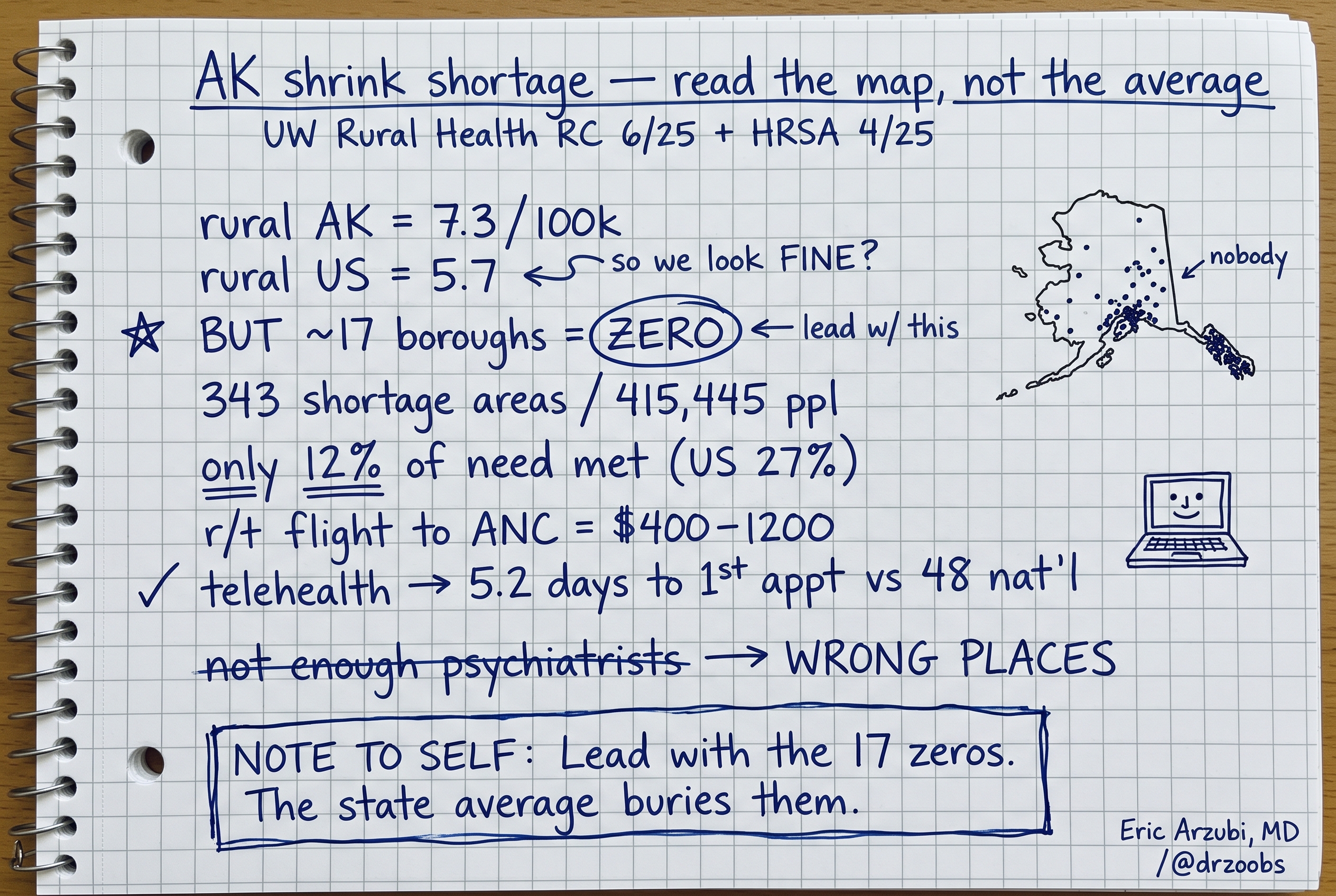
The University of Washington Rural Health Research Center reported in June 2025 that rural Alaska has 7.3 psychiatrists per 100,000 residents. That is higher than the rural U.S. average of 5.7. But the same data shows about 17 rural Alaska boroughs and census areas with a rate of zero. The statewide average is carried by a handful of places, and most of the map has nobody.
Federal shortage data tells the same story from another angle. HRSA's Health Professional Shortage Area report (data as of April 1, 2025) lists 343 designated mental health shortage areas in Alaska, covering 415,445 people. Only 11.99% of the state's mental health need is met, against a national figure of 26.67%.
Telepsychiatry is how that gap gets closed. A 2023 retrospective analysis of 1,826 patients treated entirely by telepsychiatry, published in JMIR Formative Research, found that among patients who started with at least moderate symptoms, anxiety scores fell 45.7% and depression scores fell 43.1%. Improvement did not depend on whether a patient was classified as rural or urban.
This guide covers four things: when telepsychiatry is the right choice, how the process works, what your insurance covers, and how to check a provider before you book. If you are still deciding what kind of clinician you need, start with the difference between a psychiatrist and a psychologist.
When Telepsychiatry Is Appropriate, and When It Isn't
Telepsychiatry works for most psychiatric conditions. It does not work for all of them. Knowing the difference before a crisis is worth a few minutes now.
When remote care is the right choice
Telepsychiatry is well suited to:
- Initial evaluations for depression, anxiety, ADHD, PTSD, bipolar disorder, OCD, and most mood and anxiety disorders
- Medication management, including new prescriptions, dose changes, and refills
- Ongoing follow-up for patients who are stable or improving
- Medication treatment for alcohol and opioid use disorder
- Child and adolescent psychiatry, including behavioral assessments and medication management
- Continuing care after a move or after a provider leaves the state
If ADHD is what brought you here, we cover the evaluation process in more depth in getting help for ADHD in Alaska.
A 2023 thematic review in BJPsych Bulletin pulled together 325 papers on telepsychiatry and found that virtual consultation diagnosed common psychiatric disorders as reliably as a face-to-face visit, with satisfactory outcomes across depression, anxiety, PTSD, ADHD, and substance use disorders.
When you need in-person or emergency care
Get in-person or emergency care if:
- You are in a psychiatric emergency, including suicidal thoughts with a plan, a suicide attempt, or a crisis that puts you or someone else at immediate risk
- You are showing signs of acute psychosis for the first time and have not been examined in person
- You need a physical examination, because some conditions require labs, imaging, or hands-on assessment before a diagnosis is safe
- You are in acute alcohol or opioid withdrawal and need medical monitoring
If you are in a psychiatric emergency in Alaska, call or text 988 to reach the Suicide and Crisis Lifeline, go to your nearest emergency room, or call 911. A telepsychiatry provider can help prevent a crisis and can help after one, but is not a substitute for emergency services.
How Remote Psychiatric Care Works
Many people who would benefit from care never start, because the process feels like a black box. Here is what actually happens.
Step 1: Scheduling
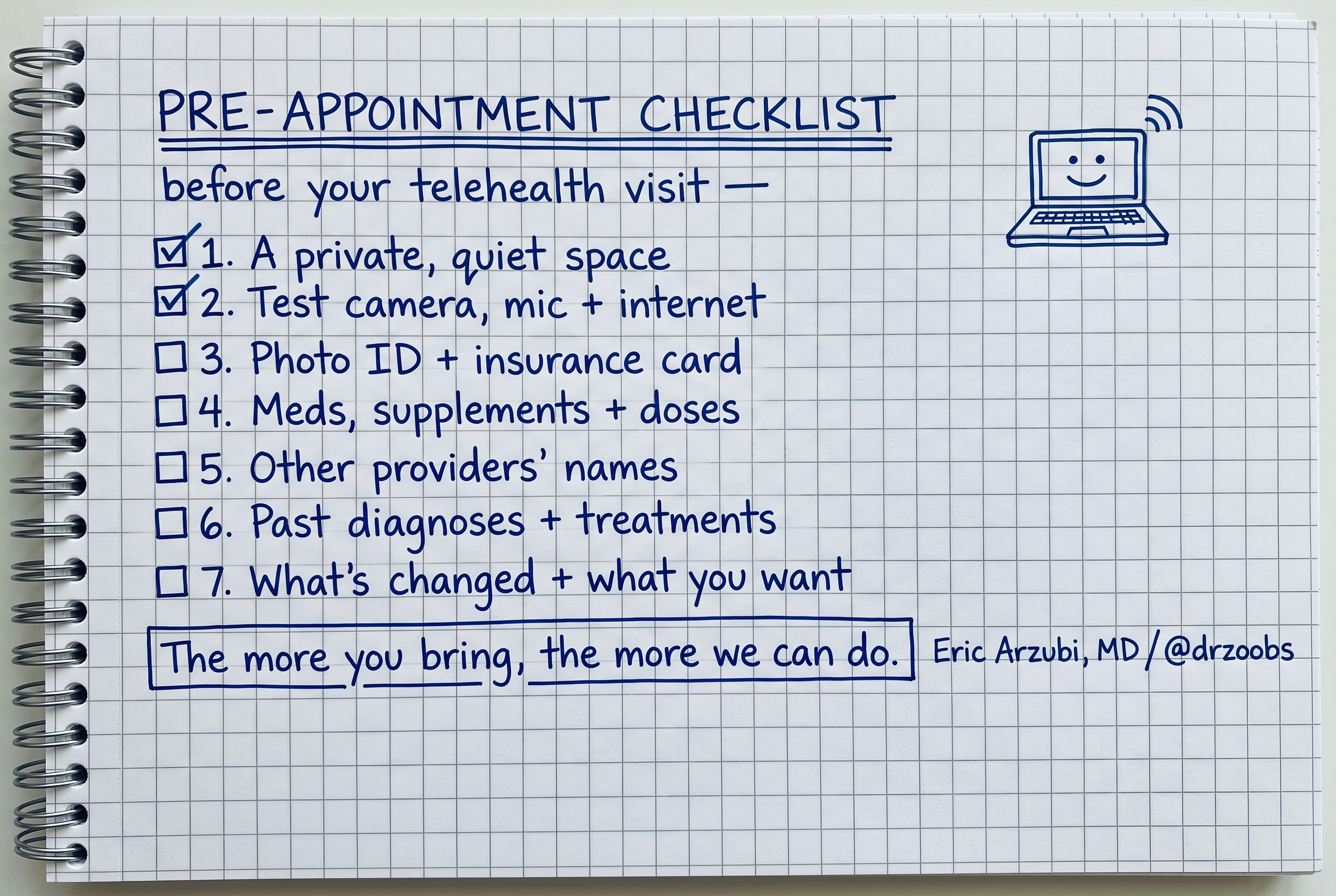
With a telepsychiatry provider licensed in Alaska, you usually book online or by phone. You do not need a referral from a primary care doctor. Many providers offer appointments within one to two weeks. Before your visit you fill out intake forms covering your symptoms, medical history, current medications, and what you want to work on.
Step 2: The initial evaluation
Your first appointment is a full evaluation, usually 45 to 60 minutes, by secure video. The psychiatrist reviews your history, asks about your symptoms in detail, assesses how severe and how long-standing they are, and talks through your goals. This visit is diagnostic. The psychiatrist is building a clinical picture, not just writing a prescription.
By the end of it you should have a diagnosis or a working impression, a treatment plan, and, if it is appropriate, a prescription sent to your pharmacy.
At Frontier Psychiatry, initial evaluations are 60 minutes with a licensed psychiatric provider, including psychiatrists, specialty-trained nurse practitioners, and physician assistants, by secure video. No referral is required, and most major insurance plans are accepted, including Medicaid.
Step 3: Medication management and follow-up
Follow-up visits are at least 30 minutes and happen every four to eight weeks depending on your condition and how stable you are. They cover how you are responding to your medication, any side effects, dose changes, refills, and coordination with your therapist or primary care provider.
This is where Alaska patients gain the most. A February follow-up does not require a flight to Anchorage or a drive on icy roads.
Step 4: Care coordination
A good telepsychiatry provider does not work in isolation. If you have a therapist, your psychiatrist should coordinate with them, share notes with your consent, and align on the plan. If you need bloodwork, for lithium levels or thyroid function or other medication monitoring, your provider orders it and you have it drawn locally.
If you are already in therapy and not getting better, that is worth raising at your first visit. Our QuickCheck tool walks through whether your current treatment is at an adequate dose and duration.
What Insurance Covers, Including Medicaid
Cost is the barrier people ask about most, and it is usually smaller than they expect. Here is how the main coverage pathways work in Alaska.
Alaska Medicaid
Alaska Medicaid covers behavioral health services delivered by telehealth. State law (AS 47.07.069) directs the department to reimburse behavioral health services provided through telehealth, and the regulations (7 AAC 110.625) cover care delivered by real-time, two-way audio-video technology. Audio-only telephone visits are also reimbursable, which matters in communities where video is not dependable.
You do not need to have seen the psychiatrist in person first. Alaska law lets providers deliver telehealth without a prior in-person visit.
To use Medicaid for a telepsychiatry visit, have your Medicaid ID number ready at intake and confirm the practice is an enrolled Alaska Medicaid provider. If you are looking for a psychiatrist who takes Medicaid, ask that question before you book rather than after.
Denali KidCare
If you are a parent looking for care for a child, Denali KidCare is Alaska's Children's Health Insurance Program. It covers children from birth through age 18, and pregnant women, who meet the income limits. Coverage for children is generally issued 12 months at a time, and renewal notices go out about 45 days before it expires.
Apply through the Alaska Connect Portal or the federal marketplace at Healthcare.gov. For income thresholds and eligibility questions, the Division of Public Assistance can be reached at 800-478-7778.
TRICARE
Alaska has a large military and veteran population, and TRICARE covers telemental health. Referral and authorization rules vary by plan and by region, so check with your regional contractor before your first visit. Confirm that the practice is TRICARE-authorized.
Alaska Native and tribal health
Alaska Native and American Indian people have a separate pathway that is often faster and carries no cost. The ANTHC Behavioral Health Wellness Clinic serves Alaska Native and American Indian people 18 and older who are physically in Alaska, and offers assessments, individual and group counseling, and referral support by telehealth. You can reach them at 907-729-2492 or 1-833-642-2492. Your regional tribal health organization may also offer behavioral health services, including Behavioral Health Aides in many village clinics.
Private insurance
Alaska law requires health insurers to cover services delivered by telehealth and bars them from requiring a prior in-person visit (AS 21.42.422). Note that the law does not require insurers to pay the same rate for a telehealth visit as an in-person one, so your plan's specific benefits still matter. Ask the practice to verify your benefits before your first appointment.
Alaska-Specific Barriers and How to Work Around Them
Most general telehealth advice is written for the Lower 48. These are the obstacles that are particular to Alaska.
Distance and geography
Alaska is the largest state with one of the lowest population densities, and many communities have no road connection. For someone in the Yukon-Koyukuk, Kusilvak, or North Slope regions, the nearest psychiatrist may be reachable only by small plane. Telepsychiatry removes that trip. Your appointment happens wherever you have a device and a connection.
Specialist shortage
Waitlists for in-person psychiatric care in Alaska routinely run three to six months. A psychiatrist who holds an Alaska license but works from elsewhere can treat you legally, which widens the pool well beyond the clinicians who live here.
Connectivity
Internet access is still uneven in remote Alaska. If your connection is unreliable:
- Take the appointment somewhere with better service, such as a library, health clinic, or tribal health office
- Ask whether the provider offers audio-only visits as a backup, since Alaska Medicaid reimburses them
- Check the Alaska Broadband Office for programs that are expanding service in your area
Weather and seasonal isolation
Winter creates real barriers to in-person care, and seasonal affective disorder is more common here than at lower latitudes because of how much daylight is lost. Telepsychiatry fits winter care well. You can keep an appointment during a storm, and seasonal medication changes can happen when you need them rather than at the next clinic visit in spring.
Travel costs
A round-trip flight from a rural community to Anchorage can cost $400 to $1,200 or more. For monthly follow-ups, that adds up fast. Telepsychiatry removes the travel cost entirely. A systematic review of 25 economic evaluations of telepsychiatry programs in the Journal of Telemedicine and Telecare found that 60% cost less than in-person comparison care, though 32% cost more. For Alaska patients, the travel savings sit on top of whatever the care itself costs.
How to Check a Provider Before You Book
Not every telepsychiatry platform is equal. Confirm these four things first.
1. Alaska licensure
A psychiatrist generally must hold an active Alaska medical license to treat you here. Alaska law allows a few narrow exceptions for out-of-state physicians (AS 08.02.130). Those mostly involve an existing patient relationship with a prior in-person exam, or a life-threatening condition referred by an Alaska-licensed physician. For ordinary outpatient psychiatric care, the license is the requirement.
Verify it yourself using the Professional License Search Tool at the Alaska Division of Corporations, Business and Professional Licensing. Search the provider's name and confirm the license is current and in good standing. If a platform will not tell you which licensed clinician you will see before your appointment, treat that as a warning.
2. Insurance and billing
Ask directly whether the practice accepts your plan, and whether that includes Medicaid or TRICARE if those apply to you. Get it confirmed before the first appointment. Most reputable practices verify your benefits during scheduling. If a platform wants full payment up front before it will confirm coverage, be careful.
3. Wait times
Ask how soon you can get an initial evaluation, and how soon follow-ups happen after that. Some platforms advertise same-week availability but have long real waits once you are in the queue.
For reference, a 2026 evaluation of one national telehealth outpatient mental health program, published in Healthcare, found a mean time to first appointment of 5.2 days for rural patients, against a national behavioral health average of 48 days.
4. Prescribing
Ask whether the provider can prescribe what your condition is likely to need. Most psychiatric medications, including antidepressants, mood stabilizers, and non-stimulant ADHD medications, can be prescribed by telehealth without special restriction.
Controlled substances, including stimulants for ADHD, follow DEA rules. The DEA has extended its telemedicine prescribing flexibilities through December 31, 2026. Under that rule, a DEA-registered clinician can prescribe Schedule II through V medications by telemedicine without a prior in-person exam, subject to conditions. These rules have now been extended four times and could change again. If stimulant medication is part of your history, ask a prospective provider how they handle it.
Frequently Asked Questions
Can an online psychiatrist prescribe meds?
Yes. A psychiatrist licensed in Alaska can prescribe medication after an evaluation by video and send it to your local pharmacy. Most psychiatric medications carry no telehealth-specific restriction. Controlled substances such as ADHD stimulants follow DEA rules, which currently permit telemedicine prescribing through December 31, 2026.
Can you get diagnosed by a psychiatrist online?
Yes. A 2023 review of 325 studies found that virtual consultation diagnosed common psychiatric disorders as reliably as face-to-face assessment. Your psychiatrist takes a full history, assesses your symptoms, and reaches a diagnosis the same way they would in an office. Conditions needing a physical exam or lab workup may require an added in-person step.
What are the legal requirements for telehealth services in Alaska?
A physician generally must hold an active Alaska medical license to treat a patient located in Alaska, with narrow exceptions for out-of-state physicians under AS 08.02.130. Alaska does not require a prior in-person visit before telehealth care. State law also requires insurers to cover telehealth services and bars them from demanding in-person contact first.
Can I go straight to a psychiatrist?
Yes. You do not need a referral from a primary care doctor to see a psychiatrist in Alaska, and most telepsychiatry practices let you book directly. Some insurance plans require a referral for coverage even when the provider does not, so check your specific plan first.
Why is it so hard to see a psychiatrist?
Supply. Alaska has 343 designated mental health shortage areas covering 415,445 people, and only about 12% of the state's mental health need is met. Roughly 17 rural boroughs and census areas have no psychiatrist at all. Telehealth widens the pool to every psychiatrist licensed in Alaska rather than only those nearby.
Does insurance cover telepsychiatry in Alaska?
Usually, yes. Alaska Medicaid covers behavioral health by telehealth, including audio-only visits. State law requires private insurers to cover telehealth services and prohibits them from requiring a prior in-person visit, though it does not require them to pay the same rate as for office visits. TRICARE covers telemental health. Confirm your plan's benefits with the practice before your first appointment.
When do I need in-person care instead of telepsychiatry?
Seek in-person or emergency care during a psychiatric emergency, including suicidal thoughts with a plan, a suicide attempt, or acute psychosis. The same applies if you are in medical withdrawal from alcohol or opioids, or if your psychiatrist decides a physical examination is clinically necessary. For most outpatient psychiatric care, telepsychiatry is a well-supported option.
Key Takeaways
- You can see a psychiatrist in Alaska by secure video without a referral, and most major insurance plans cover it, including Medicaid.
- About 17 rural Alaska boroughs have zero psychiatrists. Telepsychiatry widens the pool to every provider licensed in the state.
- Telepsychiatry works well for depression, anxiety, ADHD, PTSD, bipolar disorder, OCD, and medication treatment for substance use disorders.
- Verify that any provider holds an active Alaska medical license before booking. You can check it yourself at the Alaska Division of Corporations, Business and Professional Licensing.
- If you are in a psychiatric emergency, call or text 988, go to your nearest emergency room, or call 911. Telepsychiatry is not a substitute for emergency care.
Taking the First Step
The hardest part of getting psychiatric care in Alaska is often not the shortage of clinicians. It is the belief that getting help will take more travel, money, and effort than you can sustain. For most people, telepsychiatry removes that.
What you are looking for is a licensed psychiatric provider, whether a psychiatrist, nurse practitioner, or physician assistant, who is licensed in Alaska, takes your insurance, and can see you soon. That is a reasonable standard, and it is achievable.
If you are trying to help someone else start, our guide to supporting a loved one with depression covers how to raise it without pushing them away. You can also meet the providers on our psychiatric team before you book.
Frontier Psychiatry is licensed in Alaska, accepts most major insurance plans including Medicaid, and offers evaluations with a psychiatric team that includes psychiatrists, specialty-trained nurse practitioners, and physician assistants, all by secure video. No referral required.
Check your insurance coverage or book an evaluation.
Written and reviewed by Eric Arzubi, MD, Assistant Clinical Professor at the Yale School of Medicine; CEO and Co-Founder of Frontier Psychiatry.